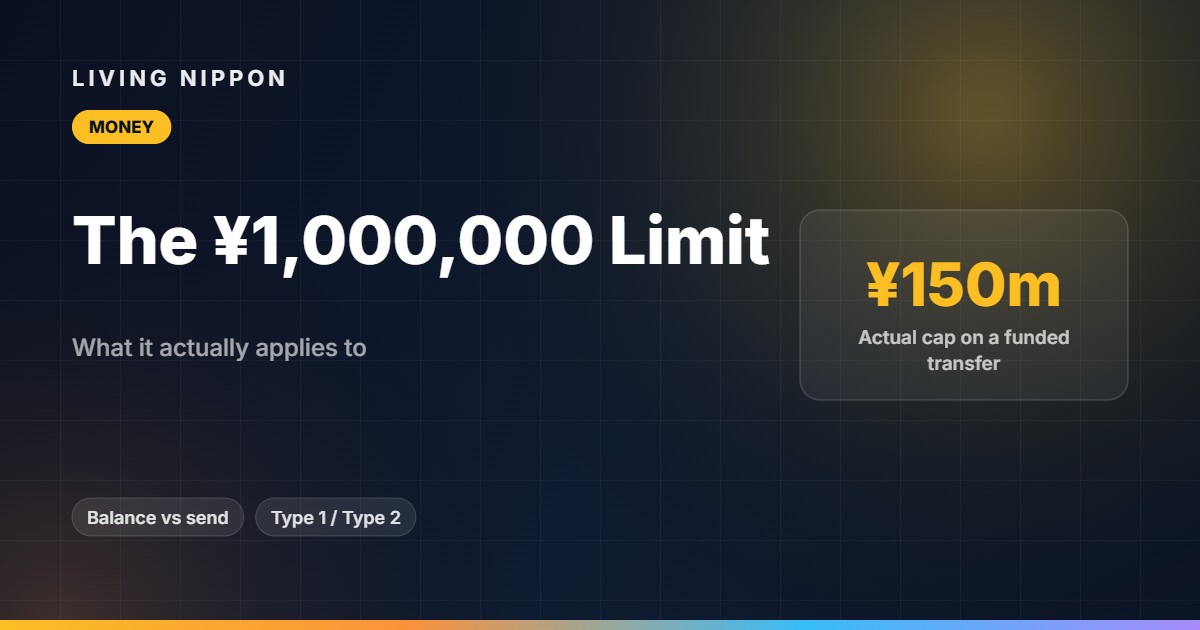
- "Wise caps you at ¥1,000,000 in Japan" is wrong. A transfer funded from outside Wise — by bank transfer or debit card — can go up to ¥150,000,000 equivalent in a single transaction.
- The ¥1,000,000 ceiling attaches to the Wise balance: topping it up, sending from it, withdrawing from it, and how much you may hold in it.
- You can hold ¥1,000,000 across all currencies and Jars combined. On request that can be raised to ¥20,000,000 for up to six months. Go over, and there is a 30-day grace period during which sending and card use continue.
- ¥1,000,000 is the statutory ceiling on Type 2 funds transfer business in Japan. That is why SBI Remit, Seven Bank, Kyodai and DCOM all stop at exactly the same figure.
- Wise holds both a Type 1 and a Type 2 registration, so a transfer above ¥1,000,000 is switched to the Type 1 route automatically — no extra step, no splitting, no separate product.
- Where the balance cap genuinely hurts: paying a property deposit abroad, moving savings out of Japan, and receiving money into Wise while you live in Japan.
Ask in any foreign residents' group in Japan how much you can send with Wise and someone will answer "one million yen" within a minute. It is the single most repeated number about Wise in Japan, and it is wrong in the way that matters most — it is attached to the wrong thing. There is a ¥1,000,000 wall, it is real, and it is nothing to do with the size of the transfer you can send. If you are trying to send ¥4,000,000 to buy a flat in Manila or move your savings home before you leave Japan, the limit that everyone quotes at you does not apply. This article sorts out which limit applies to what.
The correction: the cap is on the balance, not on sending
Wise in Japan is operated by Wise Payments Japan K.K. (ワイズ・ペイメンツ・ジャパン株式会社), based in Chuo-ku, Tokyo. It is not a bank. It is a registered funds transfer service provider (資金移動業者), registered with the Kanto Local Finance Bureau (関東財務局長) as No. 00040 since 18 August 2015.
That single legal fact is the source of all the confusion, because Japanese law splits funds transfer registration into types with different ceilings — and Wise holds two of them. The number people repeat, ¥1,000,000, belongs to one of those types. It does not describe the whole company.
Concretely: if you fund a transfer from outside Wise — by transferring yen from your Japanese bank account, or by paying with your debit card — the transfer limit is ¥150,000,000 equivalent per transaction. If you first move money into your Wise balance and then send from the balance, you are inside the ¥1,000,000 world. Same app, same recipient, different limit, purely because of how the money was funded.
The five limits, laid out
There are five distinct numbers, and almost every argument about "the Wise limit" is two people quoting different rows of this table at each other.
| What you are doing | Limit |
|---|---|
| Sending, funded from outside Wise (bank transfer or debit card) | ¥150,000,000 equivalent per transfer |
| Topping up your Wise balance | ¥1,000,000 per top-up |
| Sending from your Wise balance | ¥1,000,000 per transfer |
| Withdrawing from Wise | ¥1,000,000 equivalent per withdrawal |
| Holding a balance (all currencies and Jars combined) | ¥1,000,000, raisable to ¥20,000,000 on request for up to six months |
Read that table once more with the practical question in mind. The only thing that lets you move a large sum in one go is the first row, and the first row is the one nobody quotes. Everything else is the balance — money parked inside Wise rather than passing through it.
This also explains a piece of behaviour that confuses people. Someone tries to send ¥1,500,000, gets a limit message, tops up their balance instead, hits ¥1,000,000, and concludes the wall is real. It was real — for the route they chose. Funding the same ¥1,500,000 directly from their bank account or debit card at the point of setting up the transfer would not have hit it.
The ¥150,000,000 figure is a per-transfer limit on the sending side in Japan. It says nothing about what your bank will let you push out in one transfer, or what your recipient's country allows in. Both of those are separate ceilings with their own rules, and they are frequently lower.
Why ¥1,000,000 exists at all
The number is not a Wise product decision. It is the statutory ceiling on Type 2 funds transfer business (第二種資金移動業) in Japan. An operator registered under that type may not handle a single transfer above ¥1,000,000. Full stop, by law, regardless of who you are or how long you have been a customer.
Once you know that, a pattern in the market stops looking like a coincidence. Every specialist remittance service used by foreign residents in Japan stops at the identical figure:
| Service | Registration | Ceiling |
|---|---|---|
| Wise | Type 1 and Type 2, Kanto Local Finance Bureau No. 00040 | ¥150,000,000 equivalent per transfer when funded from outside |
| SBI Remit | Type 2, Kanto Local Finance Bureau No. 00008; Type 1 approval obtained July 2026 | ¥1,000,000 |
| Seven Bank international transfer | — | ¥1,000,000 per transfer, per day and per month; ¥3,000,000 per year |
| Kyodai Remittance | Registration number not confirmed from a primary source | ¥1,000,000 per transfer, fees included |
| DCOM Money Express | Type 2, Hokuriku Local Finance Bureau No. 00001 | ¥1,000,000 |
Four services, four different companies, four different fee structures, four different corridors of specialisation — and one identical number. They are all looking at the same wall. SBI Remit obtained a Type 1 approval in July 2026, aimed at services above ¥1,000,000; what that will look like in practice has not been published in enough detail to describe here.
Wise's position is different because it added a Type 1 registration in March 2024 and kept the Type 2 one. Type 1 is the registration that carries no statutory per-transfer ceiling. That is the entire reason Wise can quote you ¥150,000,000 while the operator next to it in the app store cannot go past ¥1,000,000. It is a licensing difference, not a marketing one.
What happens when you cross ¥1,000,000
This is the part worth knowing before you start, because it is anticlimactic in the best way: nothing happens that you have to do anything about. When a transfer exceeds ¥1,000,000, Wise routes it through its Type 1 registration automatically. You are not asked to split the amount into chunks, you do not apply for a different product, and there is no separate high-value service to sign up for. You enter the amount, and the transfer goes.
That matters more than it sounds. The standard workaround people invent for the ¥1,000,000 wall is to split a large transfer into several smaller ones — which costs several fees, arrives on several different days at several different exchange rates, and with some providers looks exactly like the kind of structuring compliance teams are trained to flag. With Wise you do not need the workaround, so do not build one.
For scale, here is what the fee looked like on a single large transfer. Sending ¥100,000 to USD, the total Wise fee was ¥987; ¥500,000 was ¥3,887; ¥1,000,000 was ¥7,510. All three were quoted on 16 August 2026 and are live quotes, not a published price list — they will not be the numbers you see. Two things about them are structural rather than momentary, though: the fee scales with the amount rather than jumping at a threshold, and the exchange rate applied at ¥100,000 and at ¥500,000 was identical, meaning the cost was fully visible in the stated fee rather than hidden in the rate. That second point is the thing worth checking yourself for your own amount and currency. If you want the same comparison run against Japanese banks, we did that in Wise vs Japanese banks on ¥100,000.
Check the number for the amount you are actually sending
Fees and exchange rates move, and a large transfer behaves differently from a small one. Put your real amount and destination currency in and compare it against what your bank quotes you before you commit.
The holding limit, the raise, and the 30-day grace period
The one limit that genuinely constrains people is the holding limit. You may hold up to ¥1,000,000 in your Wise account — and that is the total across every currency and every Jar combined, not per currency. Some euros, some dollars, a Jar you are saving into: it all counts against the same ¥1,000,000.
You can request a raise to ¥20,000,000, granted for a maximum of six months. That structure tells you what it is designed for. It is a window for a specific event — a property purchase completing, a large payment you are waiting to release, an inheritance passing through — not a permanent upgrade for people who want to keep their savings at Wise. When the six months are up, you are back at ¥1,000,000.
If your balance goes over the limit, you get a 30-day grace period. During those 30 days you can keep sending and keep using the card, so the account does not simply freeze on you. It is a runway to get the excess out, not a penalty box. Still, it is a runway with an end, so if a large sum lands unexpectedly in your Wise account, treat the clock as started.
The Wise debit card is issued in Japan — older articles saying it is not available here are out of date. But the card spends from the balance, so the ¥1,000,000 holding limit applies to it too. It is a card for spending money you are moving, not a place to keep a large cash cushion.
Who this actually bites
For most people sending money to family every month, none of the five limits will ever come up. A ¥100,000 or ¥300,000 remittance funded from a Japanese bank account never approaches any of them. Three situations are different.
Paying a deposit on a property abroad
This is a single large payment on a deadline, and it is exactly the case where the misconception costs money. Reading "Wise caps at ¥1,000,000" and concluding you must use a bank for a ¥6,000,000 deposit is a decision made on a false premise. Funded from your bank account or debit card, that transfer is inside Wise's limit. What you should check instead is the ceiling on your own bank's outgoing transfer, which is often the real constraint — Japan Post Bank's web service, for example, stops below ¥1,000,000 per transfer with a ¥2,000,000 daily and ¥5,000,000 monthly cap, and the megabanks' online channels commonly sit around ¥3,000,000 per transfer. The details are in our breakdown of Japan Post Bank and the megabanks.
Moving savings out of Japan when you leave
Here the holding limit is the awkward one. If your plan is to consolidate several years of savings inside Wise and then move it in one piece, you will hit ¥1,000,000 on the way in. The shape that works is the opposite: leave the money in your Japanese bank account and fund transfers from it directly, so the money passes through Wise rather than sitting in it. If you genuinely need it parked, that is what the ¥20,000,000 raise for up to six months is for — but it is a temporary window, so apply with the actual timeline in mind.
Receiving money into Wise while living in Japan
This is the case where we would tell you to look elsewhere. Wise does issue JPY account details for receiving, but they are SWIFT details only — not domestic Zengin receiving details — and transfers of ¥1,000,000 or less cannot be processed through them. So small domestic payments will not arrive at all, and large ones run straight into the ¥1,000,000 holding cap the moment they land. If someone is sending you yen, give them a Japanese bank account: it is faster and cheaper. We go through the options in receiving money from abroad in Japan.
The limits people confuse with these ones
Two other numbers get mixed into the conversation and belong in different categories entirely.
The first is a reporting obligation, not a limit. Under Japan's Foreign Exchange and Foreign Trade Act, a report is required for a payment or receipt of payment exceeding ¥30,000,000 equivalent, converted at the Bank of Japan's monthly standard rate. Below that, nothing is required. It does not cap what you can send and it applies to the transaction, not to the provider.
The second is funding rules, which stop transfers for reasons that have nothing to do with size. Wise in Japan does not accept credit cards, cash, or transfers from a third party's account — money must come from an account in your own name. It also does not accept salary or bonus payments, or withdrawals from a cryptocurrency exchange, as a source of funds for a top-up. That last one catches people who intend to route their pay straight through. Bank transfer top-ups take up to two business days; debit card is faster, and a debit card refund takes five to ten business days. If you have not opened the account yet, the document requirements are covered in opening a Wise account with a residence card.
One more small cost that is easy to miss on the large-transfer path: sending from a JPY balance via SWIFT carries an additional ¥181.75 fixed cost, quoted on 16 August 2026. It applies to that route only.
How to work out which limit applies to you
Three questions settle it every time. First: is the money coming from outside Wise at the moment you set up the transfer, or is it already sitting in your balance? Outside means ¥150,000,000; inside means ¥1,000,000. Second: are you moving money through, or keeping it? Keeping it means the holding limit applies, all currencies and Jars added together. Third: is the constraint even on Wise's side? Very often the binding limit is your Japanese bank's outgoing transfer cap, or a rule in the destination country about how much can be received or converted.
None of this is financial advice, and none of these figures are permanent — fees, rates and limits all change. Before a large transfer, get a live quote for your own amount and destination and compare it against what your bank tells you, in total, on the same day. For the wider picture of the options available from Japan, start with how to send money home from Japan.
FAQ
Can I really send more than ¥1,000,000 in one Wise transfer from Japan?
Yes, if the transfer is funded from outside Wise — a bank transfer from your own Japanese account, or your debit card. The limit on that route is ¥150,000,000 equivalent per transfer. The ¥1,000,000 figure applies to money moving into, out of, or sitting in your Wise balance.
Do I have to split a large transfer into several smaller ones?
No. A transfer above ¥1,000,000 is routed through Wise's Type 1 registration automatically. There is no extra step, no separate application and no different product to sign up for. Splitting would only multiply the fees.
Why do SBI Remit, Seven Bank, Kyodai and DCOM all stop at exactly ¥1,000,000?
Because ¥1,000,000 is the statutory ceiling for Type 2 funds transfer business in Japan. It is not a company policy any of them can waive. Wise can go past it because it also holds a Type 1 registration, added in March 2024. SBI Remit obtained a Type 1 approval in July 2026, but the details of what it will offer under it have not been published.
Is the ¥1,000,000 holding limit per currency?
No. It is the combined total across every currency you hold plus any Jars. Yen, dollars, euros and a savings Jar all count towards the same ¥1,000,000.
What happens if my balance goes over the limit?
There is a 30-day grace period, and during it you can continue sending money and using your Wise card. Use the time to move the excess out, or apply for the raise to ¥20,000,000, which is granted for up to six months.
Can I receive a salary or a large payment into Wise while living in Japan?
Wise's JPY receiving details in Japan are SWIFT only, and transfers of ¥1,000,000 or less cannot be processed through them. Anything larger runs into the ¥1,000,000 holding cap on arrival. For receiving yen in Japan, a domestic bank account is the better answer. Separately, salary and bonus payments are not accepted as a source of funds for topping up a Wise balance.
One quote, your amount, before you decide
The limit that applies to you depends on how you fund the transfer, so the only reliable check is to enter your own figure and destination and see what comes back. Rates and fees change daily — compare on the day you send.