Documents You Need to Rent an Apartment in Japan: The Checklist, and the Chicken-and-Egg Problem

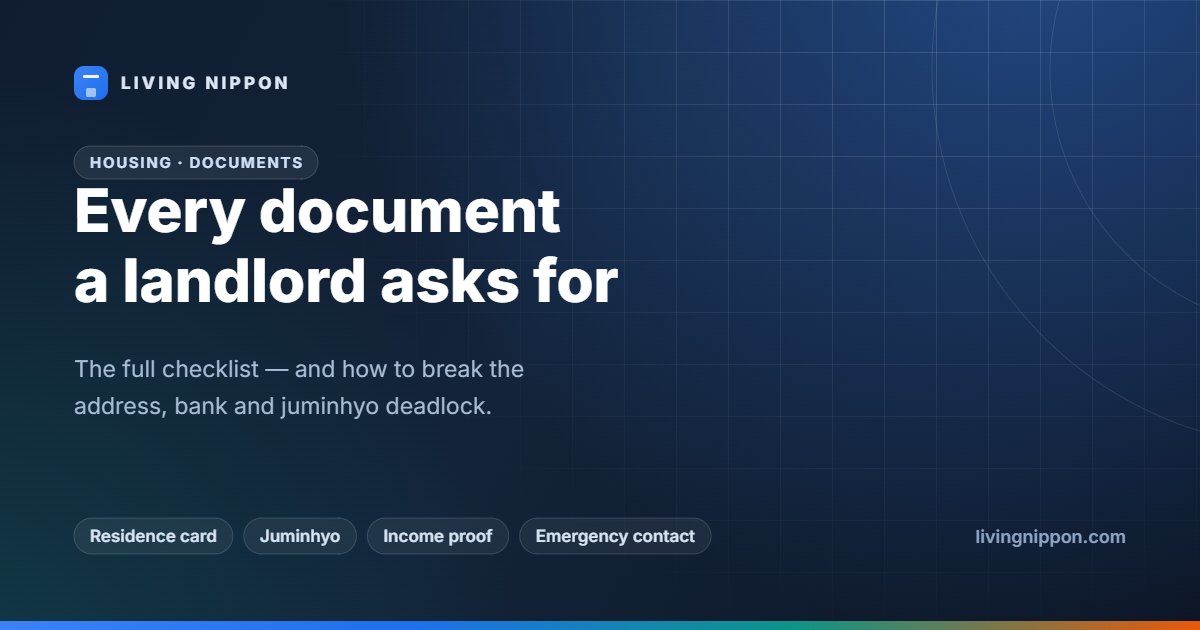
- Most applications ask for four groups of paperwork: identity, income, address registration, and payment details.
- Your residence card matters more than your passport, and the time left on it matters more than either.
- The trap: you need an address to register, registration to get a juminhyo, and often a registered address to open a bank account — yet all three are being asked of you in order to get the address.
- Applications fail on small mismatches far more often than on missing documents: name spelling, room numbers, dates.
- Requirements differ by ward office, agency and guarantee company. Treat any list, including this one, as what is commonly asked, then confirm your exact set.
- Lighter routes exist: the operator advertised here needs no guarantor, only an emergency contact, and contracts online. Tokyo, ages 18 to 49.
Short on documents, and need an address anyway?
Furnished Tokyo rooms from ¥38,000/month, roughly ¥30,000–¥50,000 to move in. No guarantor, no deposit, no key money. Ages 18 to 49, first-time users.

Nobody hands you a checklist at the airport. You find a room, the agent sends a form, and the form asks for things you either do not have yet or have never heard of. Then a second list arrives from the guarantee company, not quite the same list.
This is the checklist nobody gave you, plus the part that causes the real trouble: what to do about the documents you cannot get until after you have the apartment you are applying for.
What you will normally be asked for
Rental paperwork falls into four groups. Not everyone is asked for all of it, and a share house asks far less than a conventional landlord with a guarantee company behind them.
| Group | Commonly requested | Notes |
|---|---|---|
| Identity | Residence card (zairyu card), both sides. Passport, sometimes only the photo page and visa | The card is the main document. The back carries your registered address |
| Income | Employment contract or job offer letter; recent pay slips (often two to three months); gensen-choshu-hyo, the annual withholding statement from your employer | Students instead give an enrolment certificate (zaigaku shomeisho) plus a sponsor's income documents |
| Residence and registration | Juminhyo, a certificate of residence from your city or ward office | Only available after you register an address there. Often asked for after approval, not before |
| Payment | Bank account details for the direct debit form, or a credit card; sometimes a bank book to photograph | Some agencies and operators accept card payment instead of a Japanese bank debit |
Why the residence card outranks the passport
Your passport proves who you are. Your residence card proves you may live in Japan, in what status, and until when — and that last part is what the landlord and the guarantee company are actually reading. A card with seven months left against a two-year lease is one of the most common reasons a file goes quiet. Scan both sides: the back records address changes and permission to work outside your status, and one-sided copies come straight back.
Income documents you may not have yet
The gensen-choshu-hyo only exists if you were employed in Japan through a tax year, so a first-year arrival will not have one, and pay slips only exist after a payday. If you are applying before you start work, ask your employer to state your start date and salary on letterhead. It is weaker than pay slips, but not nothing.
The chicken-and-egg problem
Here is the loop that traps almost every new arrival. You cannot register an address until you have somewhere to live. You cannot get a juminhyo until you have registered. Many banks want a registered address, and some ask for a minimum residence period. The rent direct debit wants a bank account. All of it is being requested so that you can get the address that unlocks all of it.
The order that works in practice, after landing:
- Secure a place to live first, by whatever route asks least of you — a share house, a furnished room, company or school housing, even a month somewhere while you look. That address is the key that turns everything else.
- Register that address at the city or ward office, bringing your residence card and passport; the office records the address on the back of your card. A 14-day window after moving in is commonly quoted, but confirm the deadline and documents with the office itself.
- Get the juminhyo on the same visit or later, as a paid certificate. Ask whether you need the version showing nationality and status of residence — some agencies want that one specifically.
- Open the bank account, then the phone contract. A Japanese mobile number in your own name matters more than people expect, because screening usually includes a call.
- Then apply for the longer lease, now holding the documents you were missing.
In the interim, agencies commonly accept a residence card with no address on it yet, a hotel or temporary address on the form, and the juminhyo submitted within a set period after move-in. None of this is guaranteed — ask before you assume it, and see our overview of renting in Japan as a foreign resident for how the rest of the process fits around this.
Rules genuinely differ between ward offices, agencies, banks and guarantee companies, and nothing above is a legal requirement you can hold anyone to. Ask whoever is handling your case what they need, in writing where you can.
Skip the loop: get the address first.
Over 6,000 managed rooms in the Tokyo area, contracted online without an office visit, so you can arrange one before you fly. Multilingual support in 12 languages, weekends included.
Start a free online consultation
The details that quietly fail applications
Most stalled applications are not missing a document. They have a document that does not match another document.
- Name order and romaji spelling. Copy your name exactly as printed on the residence card: same order, same spacing, same treatment of middle names. If the card shows the surname first and your bank account shows it last, expect questions. Where passport and card differ, say so up front.
- Addresses down to the room number. Japanese addresses include the building name and room number, and the form is compared character by character against your juminhyo and card. Dropping the room number or abbreviating the building name bounces paperwork back.
- Period of stay against the lease. A standard lease runs two years. If your card expires inside a year, many guarantee companies hesitate, and some ask you to reapply after renewal. If a renewal is already filed, say so and offer the receipt as evidence.
- Hanko. Signatures are increasingly accepted and many contracts now take one without argument. Some agencies still ask for a personal seal, and a plain unregistered one from a stationery shop is usually enough. A registered seal (jitsuin) with its certificate is rarely needed for renting. Ask before you buy anything.
What changes for your situation
Students
Income documents are replaced by an enrolment certificate and usually a sponsor: a parent abroad or a relative in Japan supplying their own income proof, sometimes with a relationship document. Some schools act as guarantor or run housing schemes — ask the student office before you ask an agency.
Working holiday
The visa is short, so the period-of-stay problem arrives immediately and conventional two-year leases are often out of reach. Shorter furnished options or share houses are the usual answer, and proof of funds sometimes substitutes for employment documents.
Applying from overseas before arrival
No residence card yet, no address, no bank account, no Japanese phone number. Most conventional agencies cannot process this. What works is an operator that contracts online and accepts a foreign address and phone at application, with your card details submitted after you land.
Self-employed and freelance
Pay slips do not exist. The usual substitutes are tax return (kakutei shinkoku) copies, a tax payment certificate, bank statements showing regular income, and client contracts. Expect more scrutiny, and be ready to offer several months of rent in advance if asked. If you are turned down, our guide on what to do after a rejection covers the next moves.
The lighter route, and what it actually asks for
The paperwork burden is not fixed. It scales with the risk the landlord is taking, and operators built around short furnished stays take a different kind of risk.
The operator advertised here runs share houses, where the kitchen and bathroom are shared, and self-contained furnished apartments of one-room or 1K type with nothing shared, some approved for two occupants. On either, there is no guarantor — no hoshonin, no guarantee company screening — only an emergency contact, often family abroad. Contracting is completed online with no office visit, so it can be arranged before you arrive, when you hold nothing but a passport and a visa.
Rooms start at ¥38,000 per month against roughly ¥78,000 and up across Tokyo's 23 wards, and move-in cost is one flat package with no deposit, no key money and no agency fee — commonly ¥30,000 to ¥50,000 depending on property and plan. Budget the ¥50,000 end. Rooms include a bed, desk, chair, curtains, air conditioner, fridge, microwave, washing machine and TV. The contract runs one year, but you can stay a single month and leave on one month's notice, and transfers between properties cost nothing. By comparison, a conventional lease commonly costs four to six months of rent to move into — and needs every document above.
The limits, plainly: applicants must be 18 to 49 years old, the programme covers Tokyo and first-time users only, share houses genuinely do share facilities, and common-area and utility charges are not published — ask for the full monthly figure in writing first. Our full review is the unvarnished version, and the no-guarantor options guide compares this against UR housing and other routes.
FAQ
Can I rent without a Japanese bank account?
Sometimes. Some agencies and operators accept a credit card or convenience store transfer slips while you wait for an account. Landlords using a guarantee company usually want a direct debit set up eventually. Ask at application rather than after signing.
How do I get a juminhyo if I have never registered an address?
You cannot. It is generated from the residence register, so it only exists after you notify your city or ward office that you have moved in. Get any address first, register, then request the certificate. Many agencies accept it after move-in for this exact reason.
My residence card expires in eight months. Should I even apply?
Yes, but expect friction on a two-year lease. Apply for your extension first if you can, and mention it with the receipt. Shorter furnished or share house contracts weigh the remaining period far less heavily.
Do I need a hanko to sign a lease?
Often not — signatures are widely accepted now. Where an agency still asks, an inexpensive unregistered seal is normally sufficient; a registered seal and its certificate are rarely required for renting. Confirm before buying.
Do translations of foreign documents need to be certified?
Practice varies. Many agencies accept a plain translation with the original attached; some want one prepared by a translation company. There is no single standard, so ask what format they accept before paying for anything.
Have a passport and a visa, and not much else yet?
Tokyo share houses and self-contained furnished apartments. Emergency contact instead of a guarantor, online contracting from overseas, stays from one month. Ages 18 to 49.
Check rooms and book a consultation