- A bank transfer's cost is three separate things: a published fee, a margin hidden in the exchange rate, and correspondent bank charges. Nobody outside the bank can add them into one number, because only Mizuho publishes the margin.
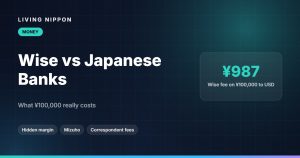
- Sending 100,000 yen to a US dollar bank account through Wise cost 987 yen in total, quoted on 16 August 2026. A megabank counter transfer starts at 7,000 yen, and that figure is the only part of the price you are shown.
- Wise applied the same exchange rate to 100,000 yen and to 500,000 yen on that date, so the whole cost sat in the stated fee. Japanese banks other than Mizuho do not publish their margin at all.
- No provider wins every case. Seven Bank can put cash in a recipient's hand in minutes; SBI Remit charges 0 yen to China above 300,001 yen; Wise cannot send to a personal bank account in China at all.
- Every specialist remittance operator stops at 1,000,000 yen per transfer, because that is the legal ceiling for a Type 2 funds transfer service provider. Wise is not limited to that on the sending side.
- Rates and fee schedules move. Price your own amount, to your own country, on the day you send.
If you live in Japan and send money home, you have probably had the experience of comparing two providers, picking the one with the lower fee, and then hearing from your family that less money arrived than you expected. That is not a mistake on anyone's part. It is how international transfer pricing is built: the number on the fee page is only part of what you pay, and for most providers in Japan the other part is not published anywhere. This article lays out every realistic option for sending money out of Japan, prices them against the same amount, and is honest about where each one loses. It is the hub of a set of guides; the country-specific and document-specific details live in the linked articles.
Why this is harder than it looks
A transfer out of Japan is priced in three separate places, and only the first is advertised. The three are not simply added together — they behave differently, they fall on different people, and one of them is invisible. That is the real finding, and it is worth stating bluntly before the numbers: for most Japanese banks, nobody outside the bank can calculate what a transfer costs.
1. The stated fee
This is the number on the fee page: 3,000 yen at Japan Post Bank, 7,000 yen at a Mitsubishi UFJ counter, 5,000 yen in the Mizuho app, 460 yen at SBI Remit for China. It is easy to compare, which is exactly why providers compete on it and why it is a poor guide to what a transfer actually costs.
2. The exchange-rate margin
When your yen becomes another currency, someone chooses the rate. If that rate is worse than the real mid-market rate, the difference is revenue, and it never appears on your receipt as a fee. On a 100,000 yen transfer, a margin of half a percent is 500 yen; two percent is 2,000 yen. It is often larger than the stated fee.
Here is what it looks like when every term is published. On 18 March 2025 we sent 150.00 EUR out of a Wise balance to a Japanese bank account. Wise deducted its fee of 2.02 EUR as a separate line, converted the remaining 147.98 EUR at a stated rate of 1 EUR = 163.080 JPY, and 24,133 yen arrived. Check it yourself: 147.98 × 163.080 = 24,132.58, which rounds to exactly the 24,133 that landed, leaving no unexplained residue. The arithmetic closed even on a small transfer, which is precisely why it is worth showing — this was a single euro-to-yen payout and it does not test the yen-out corridors most readers use, but it is the one figure in this article we measured rather than quoted. The full reconciliation, including what the stated rate and the effective rate say about each other, is in Wise vs Japanese banks: what 100,000 yen really costs.
Here is the uncomfortable part. Of the four institutions most foreign residents in Japan actually use, only Mizuho publishes the size of its margin. Mizuho states that its TTS rate has an exchange charge built into it of 1 yen per US dollar and 1.50 yen per euro. At 150 to 160 yen per dollar, 1 yen per dollar works out to roughly 0.63 to 0.67 percent, which is about 630 to 670 yen on a 100,000 yen transfer to US dollars. Mitsubishi UFJ, Sumitomo Mitsui and Japan Post Bank do not publish their margin. Neither does SBI Remit, and Seven Bank states plainly that its rate includes a margin set in advance without saying how large that margin is.
That is worth sitting with. Run the same check on a Mitsubishi UFJ, Sumitomo Mitsui or Japan Post Bank transfer and you cannot: one of the terms in the multiplication is missing, so the total will not close for you, for us, or for anyone outside the bank. For most of the options in this article it is not possible to calculate the true cost of your transfer in advance from published information, even if you are willing to do the arithmetic. That is a structural feature of the market, not a gap in this article.
One charge you will see on Japanese bank fee schedules is easy to misread, and plenty of English-language comparisons get it wrong. The yen exchange handling charge, or lifting charge, is listed by Mitsubishi UFJ at 0.050 percent with a minimum of 2,500 yen and by Sumitomo Mitsui at 0.05 percent with the same minimum. It applies only where no currency conversion takes place at the Japanese bank — a yen-denominated remittance, where the conversion happens on the receiving side, or a same-currency transfer out of a foreign currency deposit account. If you are doing the ordinary thing, handing over yen and asking the bank to send dollars or pesos, you do not pay it. The bank takes its money on the exchange rate instead. The two are alternatives, not additions, and adding them together inflates the cost of a bank transfer by 2,500 yen that a normal customer never pays.
3. Correspondent and receiving bank charges
A bank-to-bank transfer usually passes through at least one intermediary bank, and both that bank and the recipient's bank want paying. The important thing here is that these are not automatic sender-side add-ons. They are an option: elect to cover them yourself, and you pay the published amount up front; decline, and they come out of the money instead, so your recipient gets less. What changes is who pays, not whether the money disappears.
If you choose to cover them, Mitsubishi UFJ charges 3,000 yen and notes that if the shortfall exceeds 100,000 yen it may bill you separately. Sumitomo Mitsui charges 2,500 yen and states that up to 4,000 yen more can be billed to you afterwards. Mizuho charges 2,500 yen. If you do not choose to cover them, the deduction lands on the receiving end, and its size is set by banks neither you nor your Japanese bank controls.
Japan Post Bank publishes what the deduction looks like when it is taken from the money: usually nothing for the United States, 4.50 EUR for the eurozone on amounts of 100 EUR or more, 5 GBP for the United Kingdom on amounts of 101 GBP or more, and 10 USD for many other countries on amounts of 100 USD or more. Japan Post Bank also warns that this can be deducted more than once on a single transfer, because a payment can cross more than one intermediary.
So the honest summary is: with a bank, you know the published fee, you do not know the margin, and the correspondent charges are either prepaid at a stated price or subtracted somewhere down the chain at a price nobody quotes you. Three separate things, only one of them visible. If you want the full breakdown of what each Japanese bank charges and where the numbers come from, that is covered in Japan Post Bank and the megabanks: the real cost.
The categories of option
Megabank counters
Walking into a branch is the most expensive way to send money abroad from Japan, and it is also the only channel where a human being will check the recipient details with you. Mitsubishi UFJ charges 7,000 yen at the counter. Sumitomo Mitsui charges 7,000 yen to its own overseas offices and partner banks and 7,500 yen elsewhere, per its February 2026 schedule. Mizuho charges 8,000 yen for transfers to a Mizuho branch and 8,500 yen to other banks. In every case that is the published fee only; the exchange-rate margin sits on top of it, and correspondent charges sit on top of that or come out of what arrives.
Two practical warnings. Since January 2019 Sumitomo Mitsui has stopped handling foreign currency at the counter in many branches, so check the list of handling branches before you travel to one. And a counter transfer at Mitsubishi UFJ takes around three business days.
Megabank online and app channels
The same banks are meaningfully cheaper online. Mitsubishi UFJ Direct charges 2,500 yen to the bank's own overseas offices and partner banks, 3,000 yen to other banks, with a limit of 3,000,000 yen per transfer and per day and 5,000,000 yen per month. Since 9 March 2025 you can no longer send from a savings deposit account.
Sumitomo Mitsui's online personal pricing is a genuine mess. The bank's PDF schedule and its personal-banking web pages do not agree with each other; the figures sit somewhere around 3,500 to 4,000 yen, but we are not going to state a single number as fact when the provider itself publishes two. Confirm it in your own online banking before you send.
Mizuho is the interesting case. The Mizuho Direct app charges a flat 5,000 yen including tax, which is the cheapest megabank channel, and Mizuho publishes its rate margin, which no other megabank does. But there are five conditions, and one of them is a genuine catch:
- You must be an individual, not a company, and have lived in Japan for six months or more.
- You must have already made a transfer of the same kind at a Mizuho counter within the past year.
- You must have registered a debit card in the app.
- You must have submitted your My Number.
- Your registered address must match where you actually live.
Read the second condition again. To use the cheap channel you must first have used the expensive one. Someone who arrived in Japan this year and needs to send money home this month has no route to the 5,000 yen price; they pay 8,000 or 8,500 yen at the counter first. On top of that, the app allows two transfers a month, 3,000,000 yen per transfer and per day, 5,000,000 yen over thirty days, and covers seven currencies and 32 countries.
Japan Post Bank's web-only service
Japan Post Bank changed shape in 2025 and a lot of older advice is now wrong. International transfers at post office counters ended on 29 August 2025, and the route through Yucho Direct ended on 31 August 2025. What exists now is a web-only service launched in mid-July 2025. The fee is 3,000 yen per transfer. Limits are under 1,000,000 yen per transfer, 2,000,000 yen per day and 5,000,000 yen per month. The intermediary deductions described above come off the money in transit, the rate margin is not published, and we could not confirm how long transfers take.
Specialist remittance operators
These are companies registered as funds transfer service providers rather than banks, and they are usually the cheapest way to move a few tens of thousands of yen to Asia.
- SBI Remit is registered as a Type 2 funds transfer service provider, Kanto Local Finance Bureau No. 00008, and has been operating since 2010. Fees start at 460 yen. For China the fee is 460 yen, and above 300,001 yen it drops to 0 yen for UnionPay card transfers up to the equivalent of 5,000 US dollars. Vietnam runs 460 to 1,250 yen and the Philippines 480 to 1,500 yen; we could not confirm which band a transfer of exactly 100,000 yen falls into, so we are not quoting one. SBI Remit obtained Type 1 authorisation in July 2026. Its rate margin is not published.
- Seven Bank runs on the Western Union network plus a direct link to BDO in the Philippines, and prices by amount band. For 50,001 to 100,000 yen: 1,950 yen for Western Union cash pickup, 1,650 yen for a Western Union deposit to a Philippine account, 1,450 yen for cash via BDO and 1,350 yen for a BDO account deposit. You need a Seven Bank account, you must be 18 or over, and there is a screening step. Limits are 1,000,000 yen per transfer, per day and per month, and 3,000,000 yen per year. Cash pickup can land in minutes. Seven Bank cut its prices sharply on 17 September 2024, so any comparison written before that date is out of date.
- Kyodai Remittance is strongest for the Philippines, Nepal and Vietnam. Nepal costs 1,000 yen in the 30,001 to 150,000 yen band, and the United States costs 1,480 yen in the 30,001 to 250,000 yen band. The cap is 1,000,000 yen per transfer including fees.
- DCOM Money Express is registered as Hokuriku Local Finance Bureau No. 00001. Indonesia and Vietnam cost 1,000 yen in the 30,001 to 250,000 yen band, and the Philippines 1,000 yen in the 30,001 to 100,000 yen band. Note that funding a transfer from an ATM costs an extra 110 to 450 yen depending on the machine, which the headline pricing does not include.
Wise
Wise is not a bank. It describes itself as a global technology company, building the best way to move and manage the world's money; in regulatory terms, in Japan it operates as Wise Payments Japan K.K., registered as a funds transfer service provider with the Kanto Local Finance Bureau, No. 00040, since 18 August 2015, and it now holds both Type 1 and Type 2 registration, having added Type 1 in March 2024. It is a direct participant in the Zengin domestic clearing system with financial institution code 0200.
The reason Wise is worth taking seriously in a cost comparison is the second price. On 16 August 2026 we pulled live quotes for 100,000 yen and for 500,000 yen from Wise's public comparison interface, and the exchange rate applied was identical at both amounts. In other words, on that date there was no rate margin: the entire cost of the transfer was visible in the stated fee. That is the central claim Wise makes about itself, and it held up when measured.
Speed is the other axis on which these categories separate, and here the figures come from Wise rather than from us. Wise publishes that 74 per cent of its transfers are instant, meaning completed in under twenty seconds, that 87 per cent take less than an hour, and that 96 per cent take less than twenty-four hours. Read those with care. They are company-wide figures covering every currency pair Wise operates, not figures for sending yen out of Japan, and the routes this article is about run slower than that average. A Wise transfer to a Vietnamese bank account is zero to one business day after conversion, and the conversion itself can take up to two business days, which is nowhere near twenty seconds. Treat the per-route timings in the destination sections below, and in the checklist near the end, as the ones that apply to you.
The trade-offs are real and they matter. You cannot fund a Wise transfer with a credit card, and you cannot fund it with cash. Wise also refuses money that comes from a crypto exchange withdrawal, and refuses salary and bonus payments as an incoming funding source, which catches people whose plan is to move their pay straight through. Funding must come from an account in your own name; third-party payments are rejected.
The salary and bonus restriction surprises people every month. If your intention is "my pay lands, I forward it", check how your funding transfer will be classified before you build a routine around it.
What 100,000 yen actually costs
All Wise figures below were quoted on 16 August 2026 and are live quotes, not a published price list. Everything else is taken from each provider's published fee schedule. The three cost columns are deliberately kept apart, because for the banks they cannot honestly be added into one figure: the correspondent column is either something you elect to prepay or something taken off the recipient's end, and the margin column is mostly blank. Exchange rates move daily and fee schedules change, so treat this as a shape rather than a promise.
| Option | Published fee on 100,000 yen | Correspondent and receiving bank charges | Exchange-rate margin | Can you compute the total? |
|---|---|---|---|---|
| Wise, to a US dollar account | 987 yen (quoted 16 Aug 2026) | Not applicable | None measured on that date | Yes |
| SBI Remit, to China | 460 yen | Not applicable | Not published | No |
| DCOM, to Vietnam or Indonesia | 1,000 yen, plus 110 to 450 yen if funded at an ATM | Not applicable | Not published | No |
| Kyodai, to Nepal | 1,000 yen | Not applicable | Not published | No |
| Seven Bank, BDO account deposit (Philippines) | 1,350 yen | Not applicable | Margin exists, size not published | No |
| Seven Bank, Western Union cash pickup | 1,950 yen | Not applicable | Margin exists, size not published | No |
| Mitsubishi UFJ Direct (online) | 2,500 yen to own network, 3,000 yen to other banks | 3,000 yen if you elect to cover them, and more can be billed later if the shortfall exceeds 100,000 yen; otherwise deducted from what arrives | Not published | No |
| Japan Post Bank, web-only service | 3,000 yen | Taken from the money: usually none for the US, 4.50 EUR eurozone, 5 GBP UK, 10 USD many other countries, possibly more than once | Not published | No |
| Sumitomo Mitsui, online | Roughly 3,500 to 4,000 yen; SMBC's own pages disagree | 2,500 yen if you elect to cover them, with up to 4,000 yen more billed later; otherwise deducted from what arrives | Not published | No |
| Mizuho app | 5,000 yen flat, five conditions apply | 2,500 yen if you elect to cover them; otherwise deducted from what arrives | Published: 1 yen per USD, 1.50 yen per EUR | Closest to yes among the banks |
| Mitsubishi UFJ counter | 7,000 yen | As for MUFG Direct above | Not published | No |
| Sumitomo Mitsui counter | 7,000 yen own network, 7,500 yen elsewhere | As for SMBC online above | Not published | No |
| Mizuho counter | 8,000 yen within Mizuho, 8,500 yen to other banks | 2,500 yen if you elect to cover them; otherwise deducted from what arrives | Published, as above | Closest to yes among the banks |
The yen exchange handling charge is deliberately absent from this table. As explained above, it does not apply to a transfer where the Japanese bank converts your yen into foreign currency, which is what almost every reader of this article is doing.
Mizuho is the only bank on which you can do a worked example, and it is worth doing precisely because it shows what the other three are hiding. Send 100,000 yen to US dollars from a Mizuho counter to another bank and you pay a published 8,500 yen, plus a disclosed margin of roughly 630 to 670 yen at 150 to 160 yen per dollar, plus 2,500 yen if you elect to cover the correspondent and receiving banks rather than let them take it off the other end. We are not going to add those into a single price, because the third one is a choice and the second one moves with the dollar. The point is that they are three real, separately sourced numbers and Mizuho is the only bank that lets you see all three. At Mitsubishi UFJ, Sumitomo Mitsui and Japan Post Bank the middle number simply does not exist in public, which means any English-language article that quotes you one total for those banks has invented part of it.
The Wise fee depends on the destination currency. These are the totals for sending 100,000 yen, all quoted on 16 August 2026.
| Destination currency | Total fee on 100,000 yen | Effective cost | Recipient gets |
|---|---|---|---|
| EUR | 878 yen | 0.878% | 537.73 EUR |
| GBP | 921 yen | 0.921% | 459.52 GBP |
| USD | 987 yen | 0.987% | 621.47 USD |
| INR | 1,027 yen | 1.027% | 59,389.34 INR |
| PHP | 1,078 yen | 1.078% | 38,169.85 PHP |
| VND | 1,244 yen | 1.244% | 16,208,427 VND |
| KRW | 1,310 yen | 1.310% | 877,450 KRW |
| NPR | 1,794 yen | 1.794% | 94,119 NPR |
| CNY | 1,833 yen | 1.833% | 4,155.77 CNY |
The fee scales with the amount rather than staying flat: for yen to US dollars on that date it was 987 yen on 100,000 yen, 3,887 yen on 500,000 yen and 7,510 yen on 1,000,000 yen. One extra charge to know about: sending from a yen balance over SWIFT adds a fixed 181.75 yen. Every figure in this table is a quote captured at one moment on one day rather than a published tariff, and the companion article linked earlier works the same numbers through against each Japanese bank in detail.
Price your own transfer before you decide anything here
The figures above are a snapshot taken on 16 August 2026, for one amount, to one currency. Your amount, your destination and the day you send will all change the answer.
The 1,000,000 yen wall, and why it exists
Look at the specialist operators again and you will notice something: SBI Remit, Seven Bank, Kyodai and DCOM all stop at 1,000,000 yen per transfer. That is not four companies independently choosing the same round number. It is the statutory ceiling on a single transfer for a Type 2 funds transfer service provider (第二種資金移動業者), which is the licence category most remittance companies in Japan hold. Sending more than that in one go requires Type 1 authorisation, which is a much heavier approval to obtain and to maintain.
This is why the ceiling shows up in different places for different providers. SBI Remit obtained Type 1 authorisation in July 2026, though the details of what it will offer above 1,000,000 yen were not published at the time of writing. Seven Bank applies 1,000,000 yen per transfer, per day and per month, with an annual cap of 3,000,000 yen. Kyodai caps at 1,000,000 yen per transfer including fees.
Wise is the case that gets misreported most often. The claim that "Wise in Japan is limited to 1,000,000 yen" is wrong as stated. Wise holds both licence types, and the 1,000,000 yen limits sit on the balance side of the product, not on sending. Funding a transfer directly by bank transfer or debit card allows up to the equivalent of 150,000,000 yen per transfer. Topping up a Wise balance, sending from that balance, and withdrawing from Wise are each capped at 1,000,000 yen, and holding a balance across all currencies and Jars is capped at 1,000,000 yen, with an application route to 20,000,000 yen for up to six months. When a transfer exceeds 1,000,000 yen, Wise switches it to the Type 1 route automatically; you do not split it or file anything. Which limit applies to which action, and what happens if you exceed the holding cap, is worked through in Wise's 1,000,000 yen limit in Japan: what it actually applies to.
One limit that applies to everyone: under the Foreign Exchange and Foreign Trade Act, a report is required for payments exceeding the equivalent of 30,000,000 yen. Below that threshold there is no report. You will see a lot of confident advice online about a 1,000,000 yen identity-verification threshold; we could not confirm that in a primary source, so we are not repeating it.
The right answer changes with the destination
There are 4,125,395 foreign residents in Japan as of the end of 2025, the first time the figure has passed four million. The largest groups are China (930,428), Vietnam (681,100), South Korea (407,341), the Philippines (356,579) and Nepal (300,992). Those five destinations behave very differently.
China: Wise cannot reach a personal bank account
This is the single most important exception in this article. A personal Wise user cannot send CNY to an individual's bank account in China. The available payout routes are a UnionPay card, Alipay and WeChat. Bank transfers exist only business-to-business and only to CIPS member banks. Wise's marketing pages can be read as promising a local bank deposit; the help centre is the accurate source, and it says otherwise.
Each route has its own ceiling: 33,000 CNY per transfer for UnionPay, with 10,000 US dollars per recipient per day and 50,000 US dollars per recipient per year; 50,000 CNY per transfer for Alipay and for WeChat. Both wallet routes expire — Alipay cancels and refunds if the recipient does not link a bank card within 72 hours, WeChat within 48 hours. And the annual per-recipient totals include money received from other providers, so a recipient who is already receiving from someone else can hit a wall with no warning to you.
Meanwhile SBI Remit charges 460 yen to China, and 0 yen above 300,001 yen for UnionPay transfers up to the equivalent of 5,000 US dollars. For anyone sending a substantial amount to family in China, that is a genuinely hard price to beat, and Wise quoted 1,833 yen on 100,000 yen to CNY on 16 August 2026 — its most expensive currency in the table. The recipient-side rules, the meaning of the 50,000 US dollar annual conversion quota, and the specific ways these transfers fail are covered in sending money from Japan to China.
Vietnam: bank deposit only, and a name-matching change
Wise sends to Vietnamese bank accounts only. There is no cash pickup and no MoMo or ZaloPay wallet payout. A handful of receiving banks are not supported at all, including HSBC Vietnam, ANZ, Citibank Vietnam, Co-opBank, and the Hanoi branches of Industrial Bank of Korea and NH Nonghyup Bank. Vietnam does not cap what a recipient may receive and permits holding foreign currency, and personal income tax does not apply to money sent from a relative abroad to a relative in Vietnam.
Two things to watch. Cash pickup through the MoneyGram network, which SBI Remit uses, pays out in US dollars, which means the recipient converts to dong at their bank's rate and pays a spread twice. A bank deposit converts once. And from 1 April 2026 the name on a Vietnamese bank account must match the holder's national ID exactly; nickname accounts are gone, which makes name mismatches more likely than they used to be.
Philippines: the receiving limit is the thing that breaks transfers
Wise supports Philippine bank accounts and a long list of wallets including GCash, Maya, GrabPay, ShopeePay, Starpay, Bayad Wallet, TayoCash and JuanCash. Bank transfers go up to 70,000,000 PHP but wallets are capped at 50,000 PHP per transfer. Cash pickup networks such as Cebuana, M Lhuillier and Palawan do not appear in Wise's guide.
The real failure mode is on the receiving side. A Basic GCash wallet can only receive 5,000 PHP per month and holds 10,000 PHP; a Fully Verified wallet receives 100,000 PHP per month and holds 100,000 PHP. Seven Bank additionally applies 50,000 PHP per recipient per day, 30,000 PHP on a first transfer, and 100,000 PHP per month counted across all senders and top-ups. If the limit is hit, the transaction is rejected, the refund takes two weeks to a month, and the sending fee is not returned. You cannot see the recipient's remaining monthly allowance from Japan. Details, plus the 2025 change letting all three formats of the Philippine national ID be used for verification, are in sending money from Japan to the Philippines.
Cash or bank deposit
If your recipient does not have a usable bank account, or needs the money today, the comparison changes completely. Wise pays into accounts and wallets, not into a hand. Seven Bank's Western Union cash pickup can be collected in minutes for 1,950 yen on a 100,000 yen transfer, and that speed is worth more than a few hundred yen in an emergency. The trade is that the rate margin is not published, so you are paying an amount you cannot calculate for a service you can actually use.
Mizuho warns that transfers to Vietnam and India can be delayed or returned if the purpose of the transfer is not written specifically in English, because the receiving bank requires it. "Family support" is better than "gift", and a vague entry is a documented cause of failure.
What to check before every transfer
- Quote your actual amount. Fees are not flat. Wise's fee scales with the amount; bank fees are flat but the rate margin scales. The winner at 30,000 yen is not always the winner at 500,000 yen.
- Ask where the rate came from. If a provider will not tell you its margin, add a working assumption for it before you compare.
- At a bank, decide who covers the correspondent charges. Electing to pay them yourself costs a stated 2,500 to 3,000 yen up front; declining means they are taken out of the money and your recipient receives less by an amount nobody quotes in advance. If the recipient needs an exact figure to arrive, choose to cover them.
- Check the recipient's receiving limit, not just the sending limit. This is what breaks transfers to GCash and to Chinese wallets, and neither cap is visible from Japan.
- Match the name exactly. Wise requires that your name, date of birth and address agree across your photo ID, your My Number document and your Wise profile. Recipient-side name rules are tightening too, in Vietnam from April 2026 and for Alipay, which wants the given name and surname separated by a space in pinyin.
- Confirm where the money is coming from. Salary, bonus payments and crypto exchange withdrawals are refused as Wise funding sources, as are payments from anyone else's account.
- Write the purpose of the transfer properly if a bank asks for it, especially for Vietnam and India.
- Leave time. A megabank counter transfer takes about three business days. Japan Post Bank to Vietnam runs three to five days. Wise to a Vietnamese bank account is zero to one business day after conversion, with conversion itself taking up to two business days. Seven Bank cash pickup can be minutes.
One thing that is not on this list: your visa status. We looked for a provider in Japan that restricts international remittance by residence status and did not find one, so do not let anyone tell you your visa type disqualifies you.
FAQ
Is Wise a bank?
No. Wise operates in Japan as a registered funds transfer service provider, Kanto Local Finance Bureau No. 00040, registered on 18 August 2015, and holds both Type 1 and Type 2 registration. It is a direct participant in the Zengin domestic clearing system with financial institution code 0200, and the account name for incoming transfers is Wise Payments Japan. Some ATMs display it as "Wise Payments Japan Bank", which Wise has acknowledged as a known display error.
Can I use a residence card to open an account, or do I need a Japanese passport?
A zairyu card (residence card) is accepted as photo ID for both permanent residents and mid-to-long-term residents. My Number card and a driving licence are also accepted. Submitting your My Number is a separate mandatory step unless you used the My Number card itself as your photo ID. Be aware that Wise's general Japanese-language help pages, which are localised from the global site, do not mention the residence card; the Japan-specific verification page does.
Can I pay for a transfer with a credit card?
Not with Wise. Bank transfer and debit card are both accepted; credit cards and cash are explicitly refused. A bank transfer takes up to two business days, though PayPay Bank is often close to instant around the clock, and debit card refunds take five to ten business days.
Do I have to report my transfers to the Japanese government?
A report under the Foreign Exchange and Foreign Trade Act is required for payments exceeding the equivalent of 30,000,000 yen, converted at the Bank of Japan's monthly standard rate. Ordinary family remittances are far below that and require no report.
Can I use Wise to receive money in Japan?
It works poorly, though be careful which direction you mean. Paying yen out of a Wise balance into your own Japanese bank account works — that is what the 18 March 2025 transfer above was. The problem is the other direction: Wise issues yen receiving details for Japan, but they are SWIFT-only rather than domestic Zengin details, and transfers of 1,000,000 yen or less cannot be processed through them. On top of that, a resident of Japan holding yen at Wise runs into the 1,000,000 yen balance cap almost immediately. For small amounts, give the sender a domestic Japanese bank account instead — it is faster and cheaper.
So which provider should I use?
It depends on where the money is going and what form the recipient needs it in. On the evidence in this article, Wise looks strong for bank deposits to major currencies because the cost is fully visible; SBI Remit looks strong for larger amounts to China; Seven Bank is the option when someone needs cash quickly; and a megabank counter is what you use when the amount is large, the destination is unusual, or you want a person to check the details with you. Get a quote from at least two of them for your own amount before you send.
Compare the total, not the headline fee
The only fair comparison is how much money reaches your family. Run your own amount and destination through more than one provider, on the day you plan to send, and compare the received amounts rather than the fees.