- The channel you choose, not the brand, decides what currency lands in Vietnam. A bank deposit converts once, into dong. Cash pickup through the MoneyGram network arrives in US dollars, which the recipient then converts again at the receiving bank's rate.
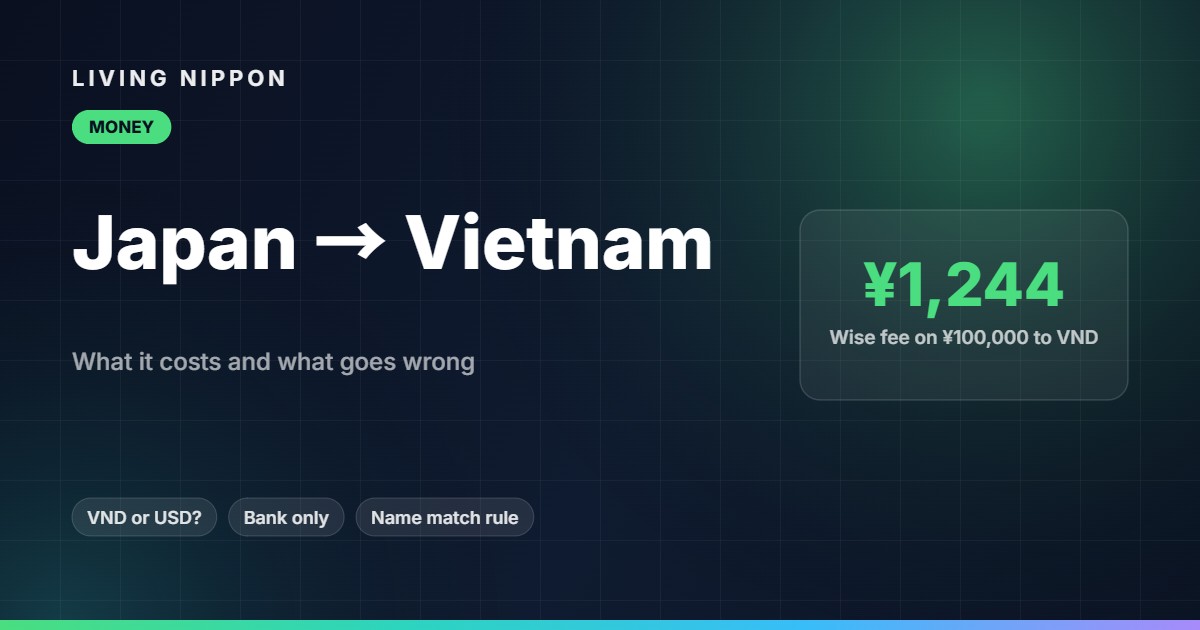
- Wise reaches Vietnamese bank accounts only. There is no cash pickup, no MoMo, no ZaloPay. Sending ¥100,000 to VND cost ¥1,244 in total fees, quoted on 16 August 2026.
- Wise cannot send to six receiving banks in Vietnam, including HSBC Vietnam, ANZ and Citibank Vietnam. Check the recipient's bank before you set up the transfer.
- Mizuho publishes a standing notice that transfers to Vietnam need the purpose of the remittance written out in English, or the money may be delayed or returned.
- From 1 April 2026, a Vietnamese bank account name must match the holder's citizen ID exactly. Name mismatches are now more likely, not less, and Wise does not issue name-amendment letters.
- Money received from family abroad is not subject to Vietnamese personal income tax, the recipient may keep it in foreign currency, and Vietcombank charges nothing to receive.
Vietnamese nationals are the second-largest group of foreign residents in Japan, 681,100 people as of the end of 2025 out of a total foreign resident population of 4,125,395 (Immigration Services Agency). A large share of them send money home on a schedule: every month, often on the same date, often the same amount. If you are one of them, the difference between a good setup and a careless one is not a single dramatic mistake. It is a few hundred yen, twelve times a year, plus the occasional transfer that sits somewhere for a week because a form field was left vague.
This article is written for the monthly sender. It covers what the main options cost from Japan, where Wise genuinely does not work for this corridor, and the failure modes on the Vietnamese side that are documented well enough to plan around.
The decision that quietly costs the most: how the money is collected
Before you compare fees, decide how your family will actually take the money, because that choice determines how many times the money is converted.
If it goes into a Vietnamese bank account, the conversion happens once, on the Japan side, and dong arrives in the account. One spread, and with a provider that publishes its cost, you can see what that spread was before you confirm.
If it is collected as cash over a counter, the picture can be different. SBI Remit states on its own pages that cash pickup through the MoneyGram network is paid out in US dollars. The recipient who wants dong then has to convert those dollars, at whatever rate the bank or counter gives them that day. That is a second spread, applied to the whole amount, and it is invisible from Japan. You will never see it on your receipt.
Two things matter about this. First, it is a property of the channel, not of the company logo on the app. The same operator can be a one-conversion product for a bank deposit and a two-conversion product for a cash pickup. Second, the confirmed case here is SBI Remit via MoneyGram. It would be wrong to tell you that every Japanese operator sends dollars for cash pickup, and this article is not going to. What you should take from it is the question to ask: what currency will my recipient physically be handed, and at whose rate? If the answer is dollars, budget for a second conversion.
If your family collects cash at a counter in a rural province, the second conversion may be a fair price to pay for a service that reaches them at all. The point is not that cash pickup is bad. The point is that comparing a cash-pickup fee against a bank-deposit fee, as if they were the same product, understates the cost of the cash option.
Where Wise fits, and where it plainly does not
The fee, measured on one day
Wise is not a bank. It operates in Japan as Wise Payments Japan K.K., a registered funds transfer service provider (Kanto Local Finance Bureau No. 00040, registered 18 August 2015), holding both Type 1 and Type 2 registrations.
On 16 August 2026 we pulled a live quote for sending ¥100,000 to Vietnamese dong:
| Sent | Total Wise fee | Effective cost | Recipient gets |
|---|---|---|---|
| ¥100,000 | ¥1,244 | 1.244% | 16,208,427 VND |
That is a quote taken on one day, not a published price list, and rates move. Quote your own amount on the day you send. What is worth understanding is the structure behind it: Wise's stated position is that its cost sits in the fee it shows you, not in the exchange rate. When we checked the same currency route at two different amounts on 16 August 2026, the rate applied was identical, so the cost really was visible in the stated fee. That is the property that makes a fee comparable at all. A bank fee of ¥3,000 is not comparable to it, because the bank fee is not the whole cost.
Wise reaches bank accounts. That is the whole list.
For Vietnam, Wise pays into bank accounts only. No cash pickup. No MoMo. No ZaloPay. The per-transfer ceiling is 499,999,999 VND, which is not the constraint most people will hit.
So the honest split is this. If your mother, your spouse or your sibling has a Vietnamese bank account and can use it, Wise is a straightforward, priced-in-the-open option and the ¥1,244 above is what you were quoted for ¥100,000. If your recipient collects cash at a counter in a rural province and has no account, Wise is not the tool for that job, and no amount of feature reading will change it. Use an operator with a cash payout network, and go in knowing the currency question from the previous section.
The six banks Wise cannot send to
Even with a bank account, one thing can stop the transfer before it starts. Wise does not send to these receiving banks in Vietnam:
- HSBC Vietnam
- Industrial Bank of Korea, Hanoi branch
- NH Nonghyup Bank, Hanoi branch
- ANZ
- Co-opBank
- Citibank Vietnam
Co-opBank in particular is worth checking, because it is a bank a family in a smaller town may well use. Confirm which bank the account is with before you build your monthly routine around one provider.
Run the numbers on the amount you actually send
The figures above are one quote from one day. If you send ¥50,000 or ¥300,000 rather than ¥100,000, the total will be different. Put your own amount in and compare it against what your bank or your current operator charged you last month.
What a Japanese bank costs on this route
Bank pricing for an outbound transfer is not one number, and you should stop trying to make it one. It is three separate things:
- The stated transfer fee. Mizuho charges ¥8,000 to its own branches and ¥8,500 to other banks at the counter, or a flat ¥5,000 (tax included) in the Mizuho Direct app. Japan Post Bank charges ¥3,000 per transfer through its web-only international service, which since late August 2025 is the only way it accepts them at all.
- The exchange rate markup. Mizuho is the only one of the major banks that publishes a figure, and it publishes it for US dollars (¥1 per dollar) and euros (¥1.50 per euro), not for dong. Every other major bank leaves the markup unpublished. That is the fact, and it is the whole argument: you cannot compare a bank against anything if the bank does not tell you its second-largest charge.
- Correspondent and receiving bank charges. Mizuho lists ¥2,500 if you elect to pay them. If you do not elect to pay them, they are deducted from the amount that arrives instead. Japan Post Bank's intermediary deduction for many destinations is USD 10 on transfers of USD 100 or more, taken out of the money before it lands, and it can be taken more than once.
Do not add these into a single total. In particular, the yen exchange handling charge (the lifting charge, 0.05% with a ¥2,500 minimum) applies only when no currency conversion happens at the Japanese bank — sending yen as yen, or sending from a foreign currency deposit in the same currency. If you convert yen into dong or dollars, which is what an ordinary personal transfer does, that charge is not part of your bill. Anyone showing you a stacked ¥8,500 total that includes it is showing you a transfer that does not exist.
One more piece of small print that catches new arrivals. Mizuho's ¥5,000 app price requires all five of: you are an individual resident in Japan for at least six months; you have already made the same kind of transfer at a Mizuho counter within the past year; you have registered the app's debit card; you have submitted your My Number; and your registered address matches your current one. The second condition is the one that stings. To use the cheap channel you must first have paid for the expensive one. If you arrived recently, the counter price is what is available to you.
Specialist operators
Vietnam is well served by dedicated remittance companies in Japan. SBI Remit is registered as a Type 2 funds transfer service provider (Kanto Local Finance Bureau No. 00008), was established in 2010, and obtained a Type 1 registration in July 2026; its published Vietnam fees run from ¥460 to ¥1,250, and it does not publish an exact figure for a ¥100,000 transfer, so treat that band as a band. DCOM Money Express (Hokuriku Local Finance Bureau No. 00001) charges ¥1,000 for Vietnam in the ¥30,001–¥250,000 band, but note that funding it from an ATM adds ¥110–¥450 depending on the machine, which the headline price does not include. Kyodai Remittance also covers Vietnam. None of these operators publishes its exchange rate margin, so the fee you see is again not the whole cost.
You may notice that the specialists all stop at ¥1,000,000 per transfer. That is not a coincidence or a risk policy. It is the statutory ceiling for a Type 2 funds transfer service provider under Japanese law. Wise holds a Type 1 registration as well, which is why its ceiling for a transfer funded by bank transfer or debit card is ¥150,000,000 per transaction, while its balance is separately capped at ¥1,000,000. Those are two different limits and confusing them is the most common misunderstanding about Wise in Japan.
What actually goes wrong on this route
This corridor has the best-documented failure modes of any from Japan. Three of them are worth building your routine around.
1. The purpose of the remittance, in English
Mizuho publishes a standing notice that for transfers to Vietnam the purpose of the remittance must be stated specifically, in English, and that if it is not, the transfer may be delayed on arrival or the funds returned. This is a requirement coming from the receiving side, not a Mizuho quirk, and it is the single most concrete piece of published guidance about this corridor from any Japanese institution.
Practically: write something a compliance officer can read and act on. "Family support" or "living expenses for my mother" is a purpose. "Transfer" is not. Do this every month, not just the first time.
2. Names, and what changed on 1 April 2026
From 1 April 2026, under Circular 30/2025/TT-NHNN, the name on a Vietnamese bank account must match the holder's citizen ID exactly. Nickname accounts are gone. This sounds like a tightening that should reduce errors, and over time it may, but in the short term it does the opposite for senders: the account name your family gave you three years ago may no longer be what the bank now holds on file, and the bank's tolerance for a near-match is lower than it was.
Ask your recipient to read you the name exactly as it appears in their banking app today, including diacritics stripped or kept as the bank shows them, and the order of the name parts. Then check it against your saved recipient before you send.
Wise does not issue name-amendment letters. If the recipient name is misspelled, there is no correction letter you can obtain to hand to the Vietnamese bank. Getting the name right before you press send is the entire remedy.
3. Funding the transfer from money that will be rejected
This one is on the Japan side and it is easy to trip over on payday. Wise accepts funding by bank transfer (up to two business days; PayPay Bank is often close to instant) and by debit card. It does not accept credit cards, cash, or transfers from an account in someone else's name. It also refuses funds identified as salary or bonus payments, and withdrawals from cryptocurrency exchanges, as a funding source. If your plan is "salary lands, I forward it straight out," that is exactly the pattern that gets stopped.
There is one more requirement worth knowing about while we are on the subject of things that stop transfers: your name, date of birth and address must match across your photo ID, your My Number document and your Wise profile. A residence card is accepted as photo ID for both permanent residents and mid-to-long-term residents, which is the situation most Vietnamese residents in Japan are in.
A fourth one, stated with its limits
Since 1 January 2026, Vietnamese accounts whose biometric data has not been synchronised with the national population database cannot use mobile or internet banking (Circulars 17/2024 and 25/2025). Whether that also blocks an incoming international transfer from crediting is not something we could confirm, so treat it as a reason for your recipient to complete the biometric step, not as a documented cause of failed transfers.
The part nobody tells you: what Vietnam does not charge
The receiving side of this corridor is unusually friendly, and readers routinely do not know it.
- No personal income tax. Under Circular 111/2013/TT-BTC, Article 3(h), money sent from a relative abroad to a relative in Vietnam is outside the scope of personal income tax. Your family does not declare it as income.
- No cap on what can be received, and no forced conversion. Under Decree 70/2014/ND-CP, Articles 6 and 13, there is no ceiling on inbound personal remittances and the recipient may keep the money in foreign currency rather than being made to convert it. If dollars arrive and the rate that week is poor, holding is an option.
- Vietcombank charges nothing to receive. An inbound transfer to a Vietcombank account is free on the receiving end.
For context on scale: Vietnam received more than USD 16 billion in remittances in 2025, and Ho Chi Minh City alone accounted for USD 10.34 billion, up 8.3%, of which USD 5.06 billion — 48.9% — came from Asia (State Bank of Vietnam, Region 2 branch). There is no official statistic for the Japan-to-Vietnam flow specifically, so be sceptical of any article that gives you one.
How long it takes
| Route | Typical time |
|---|---|
| Wise to a Vietnamese bank account | 0–1 business day after conversion; the conversion itself can take up to 2 business days |
| Cash pickup at a counter | 1 hour to same day |
| Japan Post Bank | 3–5 days |
If your family depends on the money arriving by a particular date, work backwards from the slowest realistic case, not the marketing number.
A monthly routine that holds up
Decide the channel first — account deposit or cash pickup — because that decides the currency question. Confirm the receiving bank is not one of the six Wise cannot reach, if Wise is your choice. Get the account name read to you exactly as the app shows it. Write a real purpose in English every single time. Fund from your own account, and not directly from a salary payment. And re-quote your amount every few months rather than assuming last year's comparison still holds; fees and exchange rates both move.
If you want the wider picture across providers, start with our guide to sending money home from Japan, then the head-to-head on what ¥100,000 really costs. If you bank with a megabank or Japan Post Bank, the detail is in the real cost of a bank transfer. The ¥1,000,000 confusion is unpicked in what that limit actually applies to, and if you are still gathering paperwork, see the documents you need.
FAQ
Can I use Wise to send to MoMo or ZaloPay?
No. Wise pays into Vietnamese bank accounts only. There is no e-wallet payout and no cash pickup for Vietnam.
Will my family have to pay tax on the money I send?
Money sent by a relative abroad to a relative in Vietnam is outside the scope of personal income tax under Circular 111/2013/TT-BTC, Article 3(h).
Does my recipient have to convert dollars into dong straight away?
No. Under Decree 70/2014/ND-CP, Articles 6 and 13, a recipient may hold an inbound remittance in foreign currency and there is no cap on the amount received.
I misspelled my mother's name. Can Wise send a correction letter to her bank?
No. Wise does not issue name-amendment letters. Since 1 April 2026 the account name must match the holder's citizen ID exactly, so verify the spelling with your recipient before sending rather than after.
Why did my bank ask what the money is for?
Because the receiving side asks. Mizuho publishes a notice that transfers to Vietnam need the purpose of the remittance written specifically in English, and warns that otherwise the transfer may be delayed or the funds returned.
Do I need to report my transfers to the Japanese authorities?
The reporting obligation under the Foreign Exchange and Foreign Trade Act applies to payments exceeding the equivalent of ¥30,000,000. A monthly family remittance is far below that.
Can I send more than ¥1,000,000 in one go?
With Wise, yes, if you fund it by bank transfer or debit card: the per-transfer ceiling is ¥150,000,000 equivalent. The ¥1,000,000 figure is the limit on the Wise balance, which is a different thing. Specialist operators registered as Type 2 providers do stop at ¥1,000,000 per transfer, because that is the statutory ceiling for that registration.
Compare before your next payday, not after
The ¥1,244 on ¥100,000 above was a quote taken on 16 August 2026, and this route is only relevant if your recipient has a bank account Wise can reach. Check both before you switch anything, and keep whatever comes out cheaper for your amount.