- A Wise personal customer cannot send CNY to an individual's bank account in China. This is not a delay or a restriction — the option does not exist. Bank transfer on this route is business sender to business recipient only, and only to CIPS member banks.
- The three rails available to a personal sender are UnionPay card, Alipay and WeChat. Each has its own per-transfer ceiling, its own name-format rule, and a deadline: 72 hours for Alipay, 48 hours for WeChat, after which the transfer is cancelled and refunded.
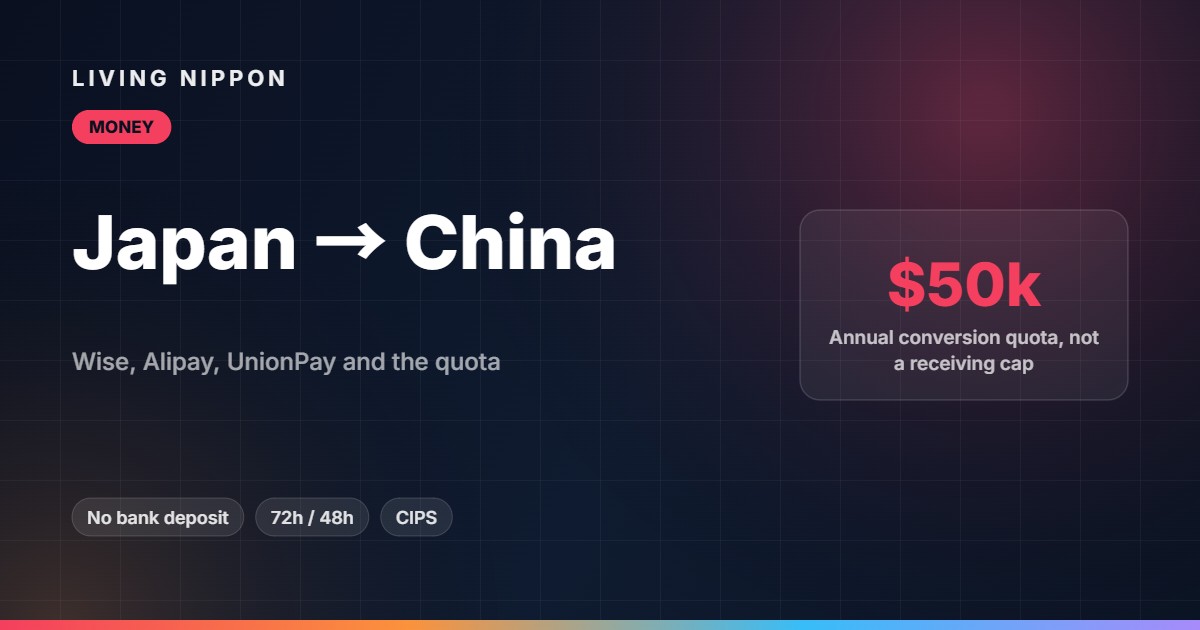
- The USD 50,000 figure is routinely described wrongly. It is an annual facilitation quota that applies separately to converting foreign currency into renminbi and to buying foreign currency with renminbi. It governs conversion inside China. It is not a cap on how much your family can receive.
- Going above the quota is not prohibited either. Family support conversions above it are possible with proof of the family relationship and evidence of the overseas payer's income.
- From 1 January 2026, individual cross-border transfers above RMB 5,000 or the equivalent of USD 1,000 carry an identity verification duty on the financial institution. The USD 50,000 quota itself did not change.
- Sending ¥100,000 to CNY cost ¥1,833 in total fees, quoted on 16 August 2026 — the most expensive of the nine currencies we quoted that day. SBI Remit charges nothing above ¥300,001 for UnionPay delivery.
Chinese nationals are the largest group of foreign residents in Japan: 930,428 people as of the end of 2025, out of a total foreign resident population of 4,125,395 (Immigration Services Agency). It is also the corridor where the published information is worst. Two claims circulate constantly, both of them wrong, and each one is capable of costing you a failed transfer or a badly planned year.
The first is that you can use a modern remittance app to deposit renminbi into a relative's bank account in China. The second is that China caps what a person may receive from abroad at USD 50,000 a year. This article deals with both properly, then sets out what actually works, what it costs from Japan, and where the transfer breaks.
Start here: Wise cannot deposit CNY into a personal bank account in China
If you take one sentence away, take this one. As a personal Wise customer, you cannot send Chinese yuan to an individual's bank account in mainland China. It is not slow, it is not conditional, it is not available.
What Wise does offer for CNY payouts to a personal recipient is three rails: a UnionPay card, an Alipay account, or a WeChat account. Bank transfer exists on this route, but it is a business-to-business product — a business sender paying a business recipient — and even then only to banks that are members of CIPS, China's cross-border interbank payment system.
Wise's own marketing pages for this route read as though a local bank deposit works. The help centre is the authoritative document, and it says what is written above. If you plan your transfer around the marketing page, the transfer will fail. This is not a small discrepancy and it is the reason this article leads with it.
The practical consequence: before you sign up for anything, ask your recipient which of the three they can actually use. A parent in their seventies who has a bank passbook but has never installed Alipay is not a candidate for the Alipay rail, and no amount of feature reading will change that. The answer to that question determines your entire setup.
The three rails, with their real limits
UnionPay card
The recipient gives you their UnionPay card number, and the money is credited to the card. Wise's limits are 33,000 CNY per transfer, and per recipient, the equivalent of USD 10,000 per day and USD 50,000 per year.
Two conditions matter. The card must be linked to a CNY account — a card tied to a foreign currency account will not do. And funds delivered this way cannot be used to purchase goods. If what you are doing is supporting a family member's living costs, that is not usually a problem, but if you were planning to pay a merchant, this rail is not for it.
Alipay
Alipay takes up to 50,000 CNY per transfer. The annual per-recipient ceiling is not one number: it depends on the stated purpose. Family support and salary payments are capped at 800,000 CNY per recipient per year, savings at 600,000, goods at 600,000, and services at 300,000. For most readers of this article the relevant figure is the 800,000 CNY family support line.
The recipient must be a mainland China national ID holder, or a resident of Hong Kong or Macau, and at least 18 years old. This trips up a specific group of people: if your recipient is a foreign national living in China — a spouse, for example — they do not have a mainland national ID and this rail is closed to them.
The name format is exact. The recipient's name must be given in pinyin, with a space between the surname and the given name. Not run together, not in any other order.
And there is a clock. The recipient has 72 hours to link a bank card to receive the money. If they do not, the transfer is automatically cancelled and refunded.
WeChat also takes up to 50,000 CNY per transfer, with an annual ceiling of 800,000 CNY per recipient and a limit of 15 transfers per month.
The clock here is shorter: the recipient must confirm within 48 hours, or the transfer is cancelled and refunded.
| Rail | Per transfer | Per recipient, per year | Deadline |
|---|---|---|---|
| UnionPay card | 33,000 CNY | USD 50,000 equivalent (and USD 10,000 per day) | — |
| Alipay | 50,000 CNY | 800,000 CNY for family support or salary; 600,000 savings; 600,000 goods; 300,000 services | 72 hours to link a bank card |
| 50,000 CNY | 800,000 CNY, and 15 transfers per month | 48 hours to confirm |
The annual per-recipient ceilings aggregate across providers. They are not "how much you may send through Wise" — they count money your recipient has received from any operator. If a sibling in Osaka has already been sending through a different company all year, your recipient can hit a ceiling that is completely invisible from your side of the transfer. If a transfer bounces for no reason you can see, this is the first thing to ask about.
Check the rail before you check the price
On this route the question that decides everything is which of UnionPay, Alipay or WeChat your recipient can actually use. Once you know that, put your own amount in and compare the quote against what you paid last time — the figures in this article are one day's quote, not a price list.
The USD 50,000 rule, stated correctly
This is the most valuable section of this article, because nearly every English-language explanation of it is wrong in the same way.
What it is not
It is not a cap on how much a person in China may receive from abroad. You will read that constantly. It is not what the rule says.
What it is
It is an annual facilitation quota for individuals. It applies to conversion, and it applies to two operations separately: converting foreign currency into renminbi, and buying foreign currency with renminbi. Each of those gets its own allowance of USD 50,000 equivalent per person per year. The sources are the State Administration of Foreign Exchange and the individual foreign exchange guides published by banks operating in China, such as HSBC China.
Read that again with the emphasis in the right place: the quota governs conversion happening inside China. It is a rule about the exchange counter, not about the inbound credit.
Exceeding it is not prohibited
This is the second half that gets dropped. Conversion above the quota is not banned. Under Article 10 of the implementing rules for the Measures for the Administration of Individual Foreign Exchange, family support conversions above the quota are possible, on the basis of documentation: proof of the direct family relationship, or a notarised document evidencing the support relationship, together with evidence of the overseas payer's income.
In other words, the quota is a threshold above which you present paperwork, not a wall. If you are supporting parents at a level that exceeds it, the route is documentation, not workarounds.
What genuinely is prohibited
Two things. Borrowing another person's quota — asking relatives and neighbours each to convert a slice under their own allowance — is not allowed. Neither is splitting a transaction into smaller pieces to stay under a threshold. These are the shortcuts people reach for precisely because they have been told the quota is a hard ceiling, which is exactly why getting the rule right matters.
An analysis, offered as analysis
Here is a piece of reasoning that follows from the rules above, but which we are not presenting as a sourced statement of fact, because it is not one. Treat it as a question to confirm with your recipient's own bank rather than as settled.
If the quota governs conversion inside China, and if money arriving through Wise, Alipay or a UnionPay card arrives already converted into renminbi, then no conversion event takes place inside China on those rails — and on that reading, nothing is drawn against the quota. Whereas a conventional bank transfer in yen or dollars lands in foreign currency, and the recipient converts it at their bank in China, which would be a conversion inside China.
That is a logical consequence of the sourced rules, not a statement any authority has published in those words. If the amounts you are sending are large enough for the difference to matter, ask the receiving bank directly and get the answer from them.
The new identity requirement from 1 January 2026
Since 1 January 2026, under changes connected to China's revised anti-money-laundering framework, individual cross-border transfers above RMB 5,000, or the equivalent of USD 1,000, carry a duty on the financial institution to verify the identity of the sender.
Two things to be clear about. First, this is an identity and record-keeping requirement, and it sits on the institution handling the transfer. Second, and this is the part that gets garbled: it did not change the USD 50,000 quota. The quota is what it was. Any article that presents the January 2026 change as a tightening of the annual allowance is conflating two different rules.
What it means in practice is that the threshold at which your details are checked is now low — RMB 5,000 is a modest monthly remittance — so expect the sending side to want your identification in order every time, not only on large transfers.
What it costs from Japan, including where Wise loses
Wise, on one day
Wise is not a bank. It operates in Japan as Wise Payments Japan K.K., a registered funds transfer service provider (Kanto Local Finance Bureau No. 00040, registered 18 August 2015), holding both Type 1 and Type 2 registrations.
On 16 August 2026 we pulled live quotes for sending ¥100,000. Here is CNY against several other destinations quoted the same day:
| Destination currency | Total fee on ¥100,000 | Effective cost |
|---|---|---|
| EUR | ¥878 | 0.878% |
| USD | ¥987 | 0.987% |
| INR | ¥1,027 | 1.027% |
| PHP | ¥1,078 | 1.078% |
| VND | ¥1,244 | 1.244% |
| KRW | ¥1,310 | 1.310% |
| NPR | ¥1,794 | 1.794% |
| CNY | ¥1,833 | 1.833% |
¥100,000 to CNY produced 4,155.77 CNY for the recipient, on a total fee of ¥1,833, quoted on 16 August 2026. China was the most expensive of the nine currencies we quoted that day — more than twice the cost of the euro route. We are not going to dress that up. If you send to China every month, this is a route where it is worth checking the alternatives carefully rather than assuming.
Those are quotes from a single day, not a published tariff, and rates move. What the same-day data does support is the structural claim: when we checked a route at two different amounts on 16 August 2026, the exchange rate applied was identical, so the cost really did sit in the stated fee rather than being buried in the rate. That is what makes a fee comparable at all — and it is also why a bank's ¥3,000 headline is not comparable to it.
Where a specialist wins
SBI Remit is registered as a Type 2 funds transfer service provider (Kanto Local Finance Bureau No. 00008), was established in 2010, and obtained a Type 1 registration in July 2026. Its China fees start at ¥460 — and for delivery to a UnionPay card, it charges nothing at all on amounts above ¥300,001, up to the equivalent of USD 5,000. On a large single transfer to a UnionPay card, that is a real advantage and you should know about it.
Two caveats to keep it honest. SBI Remit does not publish its exchange rate margin, so a zero fee is not the same as zero cost, and there is no published figure that lets you compare the rate side. And we could not confirm the exact fee for a transfer of exactly ¥100,000 to China, so do not plan around a number for that band that you have seen quoted somewhere without a source.
Japanese banks
A bank's price for an outbound transfer is not one number, and you should resist anyone who gives you one. It is three separate charges:
- The stated transfer fee. Mizuho charges ¥8,000 to its own branches and ¥8,500 to other banks at the counter, or a flat ¥5,000 (tax included) in its app. MUFG charges ¥2,500 to its own overseas offices and partners and ¥3,000 elsewhere through online banking, ¥7,000 at the counter. Japan Post Bank charges ¥3,000 through its web-only international service, which since late August 2025 is the only channel it offers.
- The exchange rate markup. Mizuho is the only major bank that publishes one, and it publishes it for US dollars (¥1 per dollar) and euros (¥1.50 per euro) — not for renminbi. Every other major bank leaves it unpublished. That is not a gap in our research; it is the state of the disclosure, and it means you cannot construct a total cost for a bank transfer to China from published figures.
- Correspondent and receiving bank charges. Mizuho lists ¥2,500 and MUFG ¥3,000 if you elect to pay them. If you do not elect to pay them, they come out of the amount that arrives instead. Japan Post Bank's intermediary deduction for many destinations is USD 10 on transfers of USD 100 or more, taken from the money before it lands, and it can be taken more than once.
Do not stack these into a single total. In particular, the yen exchange handling charge — the lifting charge, 0.05% with a ¥2,500 minimum — applies only when no currency conversion takes place at the Japanese bank: sending yen as yen, or sending from a foreign currency deposit in the same currency. If you convert yen into renminbi or dollars, which is what an ordinary personal transfer does, that charge is not part of your bill. Anyone showing you a stacked total that includes it is pricing a transfer you are not making.
One further trap on the Mizuho app price. All five of these must be true: you are an individual resident in Japan for at least six months; you have already made the same kind of transfer at a Mizuho counter within the past year; you have registered the app's debit card; you have submitted your My Number; and your registered address matches your current one. The second condition is the sharp one — to use the cheaper channel you must first have paid for the expensive one. A recent arrival simply pays the counter price.
Seven Bank, and a note about how old a notice is
Seven Bank's international transfer service covers China, with money delivered to a UnionPay card number — its notice describes the recipient account number as beginning with 62 and running to 14 to 19 digits, which is a UnionPay card number. Its stated China conditions are 80,000 CNY per day, five transfers per month, and 300,000 CNY per year, and a first-time recipient must contact a China hotline within three business days including the day the transfer is sent.
That notice is dated 2018. We are repeating it because it is the published source, but we are not going to assert that every detail is still current. Confirm with Seven Bank before building a plan around it. Separately, Seven Bank's overall limits are ¥1,000,000 per transfer, per day and per month, and ¥3,000,000 per year, an account with them is required, and its rates include a margin whose size it does not publish.
The Japan side: funding and verification
Wise accepts funding by bank transfer (up to two business days; PayPay Bank is often close to instant) and by debit card. It does not accept credit cards, cash, or a transfer from an account in someone else's name. It also refuses, as funding sources, money identified as salary or bonus payments and withdrawals from cryptocurrency exchanges. If your routine is "salary lands, forward it straight out on the same day," that is precisely the pattern that gets stopped.
For identity verification in Japan, a zairyu card (residence card) is accepted as photo ID for both permanent residents and mid-to-long-term residents. My Number submission is a separate, mandatory step — the card itself, the notification card, or a residence certificate showing your My Number issued within the past six months. Your name, date of birth and address must match exactly across your photo ID, your My Number document and your Wise profile.
On Japanese law: the reporting obligation under the Foreign Exchange and Foreign Trade Act applies to payments exceeding the equivalent of ¥30,000,000. A monthly family remittance is nowhere near it.
On limits, the ¥1,000,000 figure people quote for Wise in Japan is the limit on the Wise balance, not on a transfer. A transfer funded by bank transfer or debit card can go up to ¥150,000,000 equivalent per transaction. The two get confused constantly.
How long it takes
| Route | Typical time |
|---|---|
| Wise to a UnionPay card | Usually the same day, after the conversion completes |
| Bank SWIFT transfer (for example via Bank of China) | 3–7 business days |
If the money has to be there by a particular date, work backwards from the slower case, and add the recipient's deadline: an Alipay transfer that sits unclaimed for 72 hours does not arrive late, it arrives back with you.
What actually goes wrong
- Assuming an ordinary bank deposit works. The single most common failure, and the reason for the first section of this article.
- The recipient does not hold a mainland national ID. A foreign spouse living in China does not qualify for the Alipay rail.
- Pinyin format. Surname and given name, with a space between them. A name entered in the wrong form is a rejected transfer.
- The 72-hour and 48-hour clocks. Tell your recipient the deadline when you send, not after it has passed. Both result in cancellation and refund, which means your money comes back and the trip was wasted.
- The annual ceiling was already partly used. Because those ceilings aggregate across all providers, not just the one you are using.
One last thing worth saying plainly: there is no official statistic for the size of the Japan-to-China remittance flow. If you see one quoted confidently, it did not come from a published source.
For the wider picture, start with our guide to sending money home from Japan, then the head-to-head on what ¥100,000 really costs. If you bank with a megabank or Japan Post Bank, the detail is in the real cost of a bank transfer. The ¥1,000,000 confusion is unpicked in what that limit actually applies to, and if you are still gathering paperwork, see the documents you need.
FAQ
Can I use Wise to send yuan to my mother's bank account in China?
No. As a personal customer you cannot send CNY to an individual's bank account in mainland China. The options are a UnionPay card, Alipay or WeChat. Bank transfer on this route is business sender to business recipient only, and only to CIPS member banks. Wise's marketing pages suggest otherwise; the help centre is the authoritative document.
Is there a USD 50,000 limit on how much my family can receive?
No. The USD 50,000 figure is an annual facilitation quota applied to conversion inside China, separately for converting foreign currency into renminbi and for buying foreign currency with renminbi. It is not a ceiling on inbound credits.
What happens if the quota is exceeded?
Exceeding it is not prohibited. For family support, conversion above the quota is possible on the basis of proof of the direct family relationship, or a notarised document evidencing the support relationship, plus evidence of the overseas payer's income (Article 10 of the implementing rules for the Measures for the Administration of Individual Foreign Exchange). What is not allowed is using someone else's quota, or splitting a transaction to stay under a threshold.
Did the rules change on 1 January 2026?
An identity verification duty now applies to individual cross-border transfers above RMB 5,000 or the equivalent of USD 1,000. That is a customer identification requirement on the financial institution. The USD 50,000 quota itself did not change.
My transfer was cancelled and refunded. Why?
The most likely reasons are that the recipient did not link a bank card to Alipay within 72 hours, or did not confirm a WeChat transfer within 48 hours, or that the recipient's annual ceiling was already used up. Those ceilings count money received from all providers, not only the one you sent through, so a recipient can be at their limit without you being able to see it.
Can my recipient spend UnionPay-delivered money in shops?
Funds delivered to a UnionPay card through this route cannot be used to purchase goods, and the card must be linked to a CNY account rather than a foreign currency one.
Is Wise the cheaper option for China?
Not necessarily. On 16 August 2026, ¥100,000 to CNY carried a total Wise fee of ¥1,833, the highest of the nine currencies we quoted that day. SBI Remit charges no fee for UnionPay delivery above ¥300,001, up to the equivalent of USD 5,000, though it does not publish its exchange rate margin. Quote your own amount on both before you decide.
Do I have to report my transfers to the Japanese authorities?
The reporting obligation under the Foreign Exchange and Foreign Trade Act applies to payments exceeding the equivalent of ¥30,000,000. A regular family remittance is far below that threshold.
Quote your own amount before your next transfer
The ¥1,833 on ¥100,000 above was one quote taken on 16 August 2026, and China was the most expensive route we quoted that day. Check it against a specialist operator for your amount and your rail, and keep whichever comes out better — fees and exchange rates both move.