- There are three separate piles of paperwork: documents that prove who you are, details that identify your recipient, and evidence about the money itself. A gap in any one of them stops the transfer.
- A residence card is accepted as photo ID by Wise in Japan, for permanent residents and mid-to-long-term residents alike.
- My Number is mandatory and is a separate step, with three accepted forms of evidence. A certificate of residence must have been issued within the last six months.
- Name, date of birth and address must match exactly across your photo ID, your My Number document and your account profile. Name order, middle names, old addresses and era-calendar dates are what break it.
- The funding account must be in your own name. Third-party payments are rejected, and salary, bonus and cryptocurrency-exchange proceeds are refused as a source of funds.
- Above the equivalent of ¥30,000,000, the Foreign Exchange and Foreign Trade Act reporting obligation applies. Below that, it does not.
Most first transfers do not fail at the payment screen. They fail two days earlier, at the moment somebody realises they cannot find the notification card, or that the address on the certificate they just collected is the flat they moved out of last spring. The remedy is boring and effective: gather everything before you open anything. This article is organised around what you actually have to produce, not around which company you choose, because the same three piles of paperwork come up whichever route you take. The first pile proves who you are. The second identifies the person on the other end. The third is about the money itself, where it came from and what it is for. Miss an item in any of the three and the transfer stops, usually after you have already paid.
Pile one: proving who you are
This is the part everybody expects, and it still takes the longest, because the documents are issued by different offices at different times and have to agree with one another.
Photo identification
Wise publishes a verification page specifically for Japan, and that is the one to follow. What counts as acceptable photo ID depends on your residence status.
| Your status | Photo ID accepted |
|---|---|
| Japanese national | My Number card (preferred), driving licence, or a Japanese passport issued before February 2020 |
| Permanent resident | My Number card, driving licence, or residence card |
| Mid-to-long-term resident | My Number card or residence card |
The line that matters for most readers of this site is that the residence card works. It is accepted for permanent residents and for mid-to-long-term residents alike, so a work visa, a student visa, a dependent visa or any other mid-to-long-term status is not an obstacle on the photo-ID question. You do not have to obtain a Japanese driving licence or a My Number card first.
Wise's general Japanese-language help pages are localised versions of its global content and do not list the residence card, which has led some people to assume it is not accepted. Use the Japan-specific verification page, which does list it.
My Number: required, and a step of its own
Submitting your My Number (the individual number issued to every resident of Japan, including foreign residents) is mandatory. It is not covered by uploading your photo ID and it is not something you can defer. Plan for it as a second document task.
Three forms of evidence are accepted:
- Your My Number card.
- Your notification card.
- A certificate of residence showing your My Number, issued within the last six months.
There is one shortcut: if you used the My Number card itself as your photo ID, the number is already on the back of it, so this step is skipped. Everyone verifying with a residence card or a driving licence has to supply My Number evidence separately.
If you never collected a My Number card and cannot find the notification card, the fallback is a trip to your city or ward office for a certificate of residence with the number printed on it. Ask explicitly for the version that includes My Number, because the standard printout usually leaves it off. And note the six-month rule: a certificate you obtained a year ago for some other purpose will not do, even if nothing about your circumstances has changed. If you are also about to move house, collect the certificate after the move, not before.
The exact-match requirement
This is the requirement that quietly causes most of the delays. Your name, your date of birth and your address have to be an exact match across three things at once:
- Your photo ID.
- Your My Number document.
- The profile you filled in on your account.
Three sources, three fields, one consistent answer. It sounds like a formality. It is not, because these documents are produced by different institutions at different moments and drift apart without anyone noticing. Four drifts account for most of the trouble.
The order of given and family names. A residence card prints your name the way your passport does. Web forms ask for "first name" and "last name" and assume an order that does not hold for every nationality. If your card reads family name first and you typed it the other way round, that is a mismatch, however obvious the intent. Copy the card, field by field, in the order it is printed.
Middle names that appear on one document but not another. Plenty of people have a middle name on their passport and residence card but have never typed it into an online form in their life. If the ID shows it and the profile does not, they do not match. Enter every given name that appears on the document you are submitting.
An address that was never updated after moving. You moved, you had the reverse side of your residence card updated at the ward office, and there it stopped. The profile still carries the old address; the notification card in your drawer shows an address from years ago; the certificate of residence you are about to upload shows the current one. Any two of those disagreeing is enough to stall the application. Before you upload anything, look at all three and make them say the same thing.
Dates written in the Japanese era calendar. Documents issued in Japan often print dates using the era calendar, while your passport and residence card use the Gregorian one. The underlying date is identical, but transcribing between the two is exactly the kind of small task where a digit goes astray. Check the date of birth you typed against the Gregorian date on your ID, character by character.
One related problem deserves an honest answer rather than a confident one. Residence cards print your name in the Latin alphabet, while a Japanese bank account is normally registered in katakana. Neither Wise nor any Japanese regulator publishes guidance on how a mismatch between the two scripts should be resolved, so any step-by-step fix you find online is somebody's guesswork. What is documented is only the requirement itself: the name, date of birth and address have to match exactly, and a mismatch causes trouble. If you run into this, ask your bank and the provider's own support rather than following improvised advice.
Two practical notes to close this pile. A Japanese bank account is not formally stated to be mandatory, but it is close to necessary in practice, because funding has to come from an account in your own name. And the account-opening process itself is covered step by step in our guide to opening a Wise account in Japan with a residence card.
While you are gathering documents, price the transfer you are actually planning.
Cost depends on the amount and the destination currency, so a general comparison tells you very little. Put in your own figure and set the result next to what your bank quotes for the same amount on the same day.
Pile two: the recipient's details
People treat this half as an afterthought, a few boxes to fill in once the real paperwork is done. It is not. A missing or wrong detail on the recipient side fails just as hard as a missing document on yours, and it usually fails later, after your money has left.
What you need to collect from the person receiving the money, before you start:
- Their full legal name, spelled exactly as their bank or wallet holds it.
- The account or wallet identifier, in the format the destination country uses.
- The receiving institution, and whether that particular institution can actually be paid by the route you are using.
- Any national identifier the destination requires the account to be tied to.
The spelling point is the one to slow down on, because there is no soft landing if you get it wrong. Wise cannot issue a name-amendment letter if a recipient's name is misspelled. Some transfer routes let a bank correct a small discrepancy on request with a letter from the sending institution; here that option does not exist. Ask your recipient to read their name off the bank record itself and send it to you in writing, rather than typing what you assume it is.
Which details count as complete varies sharply by destination, and this is where the "just fill in the boxes" attitude gets expensive.
- Vietnam. Wise pays into bank accounts only; cash pickup and wallets such as MoMo and ZaloPay are not supported, and several receiving banks cannot be paid at all, including HSBC Vietnam, Industrial Bank of Korea (Hanoi branch), NH Nonghyup Bank Hanoi branch, ANZ, Co-opBank and Citibank Vietnam. From 1 April 2026, a Vietnamese bank account name must match the holder's national ID exactly, which retires the informal nickname accounts many families have used for years and makes name mismatches more likely, not less. Our guide to sending money from Japan to Vietnam goes through this in detail.
- China. Personal transfers through Wise cannot reach an individual's Chinese bank account; the available routes are a UnionPay card, Alipay or WeChat. For Alipay the recipient's name has to be given in pinyin with a space between surname and given name, the recipient must be an adult holding a mainland Chinese national ID or Hong Kong or Macau residency, and they have to link a bank card within 72 hours or the transfer cancels and is refunded. WeChat has a 48-hour confirmation window with the same consequence.
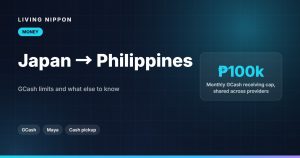
- The Philippines. Wise reaches both bank accounts and a list of wallets, but wallet receiving caps are set on the recipient's side and you cannot see their remaining monthly allowance from Japan. A GCash account on Basic verification can receive only 5,000 PHP a month; fully verified, 100,000 PHP. Exceeding a cap gets the transaction rejected, and a refund can take two weeks to a month while the transfer fee is not returned.
None of this is exotic. It is simply that "the recipient's details" is a real document-gathering task with country-specific answers, and it is worth an hour of messaging back and forth before you send anything.
Pile three: the money's own paperwork
The third pile is about the funds rather than the people. Two rules and one near-document.
The funding account must be in your own name. Payments from a third party are rejected. This catches households that run everything through one partner's bank account: that account cannot pay into the other partner's transfer account, however obviously married the two of you are. Cash is not accepted either, and credit cards are explicitly refused. The workable methods from Japan are a bank transfer, which can take up to two business days, or a debit card.
Salary, bonus and cryptocurrency-exchange proceeds are refused as a source of funds. This defeats the plan a lot of people arrive with, which is to have pay routed straight out of the country. It is a rule about where the money comes from, not about how much you send. The ordinary path still works: your salary lands in your Japanese bank account as normal, and you fund the transfer from that account, in your own name. Money coming directly out of a cryptocurrency exchange is likewise not acceptable here.
The purpose of the remittance. Mizuho publishes a standing notice that transfers to Vietnam and India must state the purpose of the remittance specifically and in English, at the request of the receiving banks, or the money may be delayed or returned. That is a bank requirement rather than a Wise one, and it is not a form you download, but in practice it functions as a document: a sentence you have to prepare in advance and phrase properly, with a real cost if you improvise. If you are sending to either country through a Japanese bank, write down your purpose wording before you sit down to make the transfer. Our comparison of what Japan Post Bank and the megabanks really cost covers the rest of the bank-side procedure.
Deciding how much to send in one go is a separate question from documents, but it interacts with them, because balance ceilings and transfer ceilings are not the same number. We untangle that in what Wise's ¥1,000,000 limit in Japan actually applies to.
The legal layer
There is exactly one Japanese reporting threshold worth putting in a checklist article. Under the Foreign Exchange and Foreign Trade Act, the reporting obligation applies to payments above the equivalent of ¥30,000,000. Below that, it does not apply.
That is the whole statement, and it is deliberately the whole statement. Thresholds circulate in expat forums that we could not confirm against a primary source, and an article that repeats them would be doing you a disservice, so this one does not. If your transfer is anywhere near the ¥30,000,000 mark, that is a conversation to have with your bank or a tax professional rather than with a website.
A gathering checklist
| Pile | What to have in hand |
|---|---|
| You | Photo ID (residence card is accepted); My Number evidence, with any certificate of residence issued within six months; name, date of birth and address identical on ID, My Number document and profile |
| Your recipient | Full name exactly as their institution holds it, in writing from them; account or wallet identifier; confirmation their institution and receiving caps can take the transfer |
| The money | A funding account in your own name; a source of funds that is not salary, bonus or crypto-exchange proceeds; a purpose statement written in English if you are sending to Vietnam or India through a bank |
Work down that table before you start rather than during, and the transfer itself becomes a five-minute job. For the wider picture of which route suits your situation, start with our overview of how to send money home from Japan.
FAQ
Can I get verified with only a residence card?
The residence card is accepted as photo ID for permanent residents and for mid-to-long-term residents. You will still have to supply My Number evidence separately, unless you used a My Number card as your photo ID.
I have lost my notification card and never collected a My Number card. What now?
Request a certificate of residence showing your My Number at your city or ward office, and ask specifically for the version that includes the number. It has to have been issued within the last six months.
My middle name is on my residence card but I never use it. Do I have to enter it?
Enter your name exactly as printed on the ID you are submitting, including every given name and in the same order. Name, date of birth and address must match exactly across your photo ID, your My Number document and your profile.
The name on my residence card is in the Latin alphabet and my bank account is in katakana. How do I fix that?
We are not going to invent a procedure for you. Neither Wise nor any Japanese regulator documents how this should be resolved. What is documented is that the names must match exactly and that a mismatch causes problems. Ask your bank and the provider's support directly.
I misspelled my recipient's name. Can it be corrected in transit?
Wise cannot issue a name-amendment letter if a recipient's name is misspelled, so do not count on a correction after the fact. Get the spelling from your recipient in writing, read off their own bank record, before you send.
Can my partner pay from their bank account into mine to fund the transfer?
No. Third-party payments are rejected. The funding account has to be in your own name.
Can I send my salary abroad the day it is paid?
Not directly. Salary and bonus payments are refused as a source of funds, as are withdrawals from cryptocurrency exchanges. Let your pay arrive in your Japanese bank account first, then fund the transfer from there.
Do I have to state why I am sending the money?
Mizuho publishes a standing notice that transfers to Vietnam and India must state the purpose of the remittance specifically and in English, or the payment may be delayed or returned. Prepare that wording in advance if either country is your destination.
At what amount do I have to report a transfer to the authorities?
Under the Foreign Exchange and Foreign Trade Act, the reporting obligation applies to payments above the equivalent of ¥30,000,000. Below that, it does not.
Documents in order? Then compare on the amount you are really sending.
Rates and fees move, so a figure quoted in an article is a snapshot rather than a price. Run a quote for your own amount and destination on the day you send, and put it beside your bank's total for the same transfer before you decide.