- This is the one corridor from Japan with a real official number attached to it: cash remittances from Japan to the Philippines were about USD 1.71 billion in 2024 (preliminary), roughly 4.9% of the country's USD 34.49 billion total, according to the central bank.
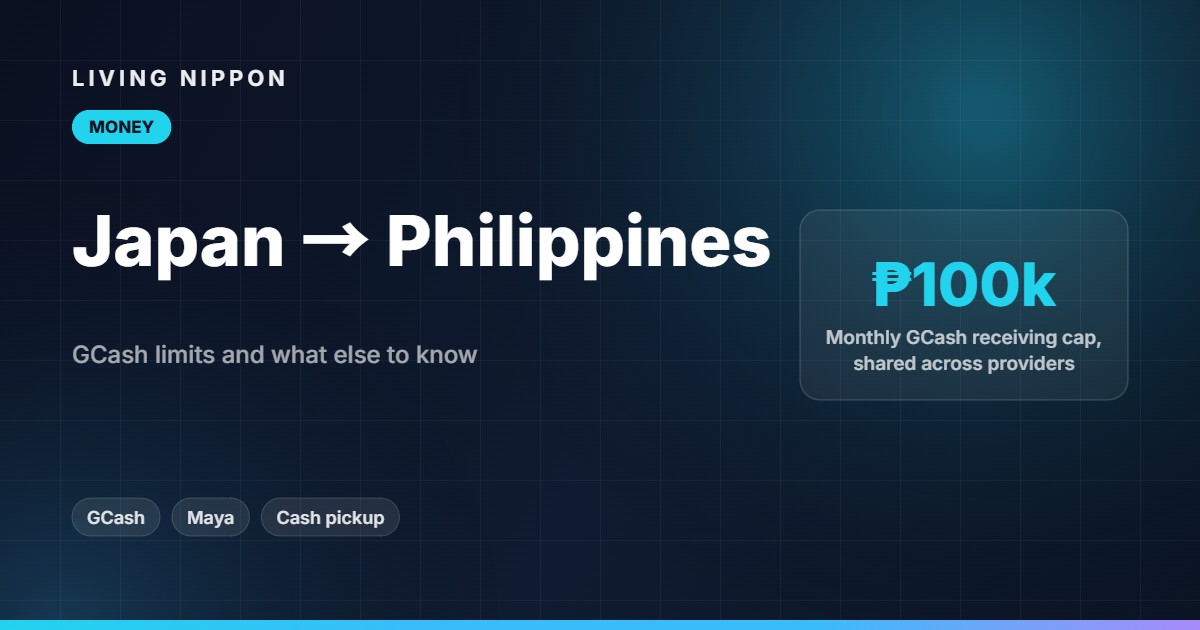
- The expensive mistake is the GCash receiving limit. A Basic account can receive only PHP 5,000 a month. A Fully Verified account can receive PHP 100,000 a month. Go over it and the transfer is rejected, the refund takes two weeks to a month, and the sending fee is not returned.
- The monthly ceiling is not per provider. Seven Bank's notice states that it aggregates money received from other remittance companies and cash-in at payment centres. You cannot see how much of it your recipient has already used.
- Wise reaches Philippine bank accounts up to PHP 70,000,000 per transfer and eight wallets including GCash and Maya, but each wallet transfer is capped at PHP 50,000. Cash pickup is not among the methods Wise lists.
- Sending ¥100,000 to Philippine pesos cost ¥1,078 in total fees, quoted on 16 August 2026. That is one day's quote, not a price list.
- On the Philippine side there is no cap on receiving foreign currency and no central bank approval needed, but only PHP 50,000 in pesos can be sent in from offshore, and a bank may hold a transfer if the purpose was not stated.
Filipino nationals are the fourth-largest group of foreign residents in Japan: 356,579 people at the end of 2025, out of a total foreign resident population of 4,125,395 (Immigration Services Agency). Most corridors out of Japan have no published figure for how much money actually moves along them. This one does. The Bangko Sentral ng Pilipinas records cash remittances from Japan at USD 1,706,720 thousand for 2024 on preliminary figures — about USD 1.71 billion, and roughly 4.9% of the USD 34.49 billion the Philippines received in total. Partial 2025 data points the same way: USD 691,909 thousand for January to May, against USD 677,632 thousand for the same months a year earlier, up 2.1%. The full-year country breakdown for 2025 has not been published yet.
So this is a large, steady, monthly flow, and it is overwhelmingly family money. Which is exactly why the single most useful thing this article can tell you is not which provider is cheapest this week. It is how a GCash receiving limit works, because getting that wrong costs you the fee, costs your family the money for up to a month, and gives you nothing back.
The GCash limit problem
GCash is the default answer for a lot of families. It is instant, it is on the phone your mother already owns, and it does not require a trip to a bank. It also has a receiving ceiling that most senders in Japan have never seen written down, because it lives on the recipient's side of the transaction.
The two tiers, and the gap between them
| GCash account status | Wallet balance limit | Amount that can be received per month |
|---|---|---|
| Basic | PHP 10,000 | PHP 5,000 |
| Fully Verified | PHP 100,000 | PHP 100,000 |
Read the middle column and the right column as two separate constraints, because they are. A Basic user cannot hold more than PHP 10,000 in the wallet, and separately cannot receive more than PHP 5,000 across the whole month. PHP 5,000 is a small number relative to what a working adult in Japan typically sends home. On the 16 August 2026 quote, ¥100,000 arrived as 38,169.85 PHP — many times over a Basic user's entire monthly receiving allowance.
The jump to Fully Verified takes the monthly receiving limit to PHP 100,000. That covers most ordinary family support, but not without thought: at that same 16 August 2026 rate, two transfers of ¥100,000 in one month would already consume most of a fully verified recipient's monthly allowance, before anything else they receive is counted.
What Seven Bank's notice adds, and why it is the part that hurts
Seven Bank publishes its own conditions for transfers to GCash, and they are worth reading even if you never use Seven Bank, because they describe how the receiving side behaves rather than how one sender behaves. As of its 1 December 2024 notice:
- PHP 50,000 per recipient per day.
- A first-ever transfer to a given GCash account is capped at PHP 30,000 in a day. Your first send to a new recipient is more restricted than your tenth.
- PHP 100,000 per month — and this monthly ceiling aggregates money received from other remittance companies and cash-in at payment centres.
That last clause is the one that catches people. The monthly limit is not "PHP 100,000 through this provider." It is PHP 100,000 into that wallet, counting the money a sibling in Dubai sent through a different company, counting the cash your recipient loaded over the counter at a payment centre in their own neighbourhood. Every one of those consumes the same allowance you are trying to use.
You have no way to see any of this. From Japan, the sending app shows you your own transfer and nothing about how much of your recipient's monthly allowance is already spent. There is no balance check, no warning screen, no "this recipient has PHP 12,000 left." The first you learn about it is when the transfer is rejected.
What happens when you go over
The transaction is rejected. The refund takes two weeks to a month to reach you. And the sending fee is not returned.
Consider what that means in practice. You send on the 25th because that is when your family needs the money. Somewhere in the Philippines, the transfer bounces off a ceiling you could not see. Your family does not get paid. You do not get your money back for two to four weeks, so you cannot simply re-send it through another route unless you have the cash twice over. And you have paid a fee for a transfer that never happened. This is not a minor inconvenience; for a household living close to the month, it is the difference between rent being paid and not.
What to actually do about it
There is no clever workaround on the sending side. The fix is a conversation with your recipient, and it takes five minutes:
- Ask which tier their GCash account is on. Not "are you verified?" — many people believe they are because they submitted something once. Ask them to open the app and read out the account status and the limits it shows. Basic versus Fully Verified is the difference between PHP 5,000 and PHP 100,000 a month.
- Ask what they have already received this month, from everyone. Other relatives sending from other countries, other remittance companies, and cash loaded at payment centres all count toward the same monthly figure.
- Treat your first transfer to a new GCash account as a smaller one. A first-ever transfer is capped at PHP 30,000 in a day under Seven Bank's stated conditions. Send a modest amount first, confirm it landed, then build up.
- For larger amounts, use a bank deposit instead. This is the real answer for anyone sending serious money. A Philippine bank account does not carry the wallet's monthly receiving ceiling, and Wise's per-transfer ceiling to a bank account is PHP 70,000,000 rather than PHP 50,000. If the amount is large, or if you are sending a lump sum on top of the usual monthly amount — school fees, a medical bill, a house repair — the wallet is the wrong container for it.
- Re-check in January. Limits reset monthly, but tiers and household circumstances change. If your recipient upgrades or downgrades, or a sibling starts sending too, your safe amount changes with it.
Price the transfer you actually make, not the example one
The ¥1,078 on ¥100,000 below was a live quote taken on 16 August 2026, and fees and rates both move. Put in your own amount and compare it against what you paid last month before you change anything.
What Wise can and cannot do on this route
Wise is not a bank. It operates in Japan as Wise Payments Japan K.K., a registered funds transfer service provider (Kanto Local Finance Bureau No. 00040, registered 18 August 2015), holding both Type 1 and Type 2 registrations.
The fee, measured on one day
| Sent | Total Wise fee | Effective cost | Recipient gets |
|---|---|---|---|
| ¥100,000 | ¥1,078 | 1.078% | 38,169.85 PHP |
That is a live quote pulled on 16 August 2026, not a published tariff. What makes it comparable to anything is the structure behind it: Wise's position is that its cost sits in the fee it shows you rather than in the exchange rate, and when we checked the same route at different amounts on that date the applied rate was identical. So the stated fee really was the cost. A Japanese bank's stated fee is not the whole cost, which is why the two numbers cannot be put side by side without adjustment.
Where the money can land
For the Philippines, Wise pays into bank accounts and into eight wallets: GCash, Maya (formerly PayMaya), GrabPay, Starpay, Bayad Wallet, TayoCash, ShopeePay and JuanCash. The ceilings are very different depending on which you pick:
| Destination | Wise limit per transfer |
|---|---|
| Philippine bank account | PHP 70,000,000 |
| Wallet (GCash, Maya and the others) | PHP 50,000 |
The PHP 50,000 wallet cap interacts badly with everything in the previous section. On the 16 August 2026 rate, a ¥100,000 transfer landed comfortably under it, but not by a huge margin — the wallet ceiling sits not far above a transfer of that size. And splitting a larger amount into two wallet transfers does not help, because both of them count against the same PHP 100,000 monthly receiving allowance on the GCash side. Two ceilings, from two different organisations, stacked on top of each other. For anything beyond routine monthly support, the bank account route removes both.
The thing Wise does not do here
Cash pickup is not among the payout methods Wise lists for the Philippines. Cebuana Lhuillier, M Lhuillier, Palawan — the pawnshop and padala counters that a great many Filipino families actually use — do not appear in Wise's guide. Wise has not published an explicit denial, but a method that is absent from the list of methods should be treated as unavailable.
For a family that collects at a counter because nobody in the household has a bank account or a smartphone wallet, that is decisive. It is not a detail to work around; it means Wise is not the tool for that job, and you should use an operator with a cash payout network instead. Say so plainly to yourself before you spend an evening comparing fees that do not apply to you.
What the Philippine side allows, and what it does not
The receiving rules here are more generous than most people expect, with one specific exception that explains a lot of confusing advice.
- There is no limit on receiving foreign currency, and no central bank approval is needed. Your recipient can receive an inbound foreign currency transfer of any size without asking the Bangko Sentral ng Pilipinas for anything. They may keep it in foreign currency or convert it to pesos; that is their choice.
- But only PHP 50,000 in pesos can be sent into the country from offshore. Peso-denominated inbound transfers to a domestic bank are capped at PHP 50,000; anything above that has to be sent in a foreign currency and converted on arrival. This is precisely why sending yen or dollars is the normal route for larger amounts, and why a service that quotes you a peso amount is doing the conversion before the money crosses the border, not after.
- Carrying cash is a different matter. Physical currency above the equivalent of USD 10,000, or above PHP 50,000, must be declared on entry.
- State the purpose of the transfer. A bank may hold a transfer if the purpose was not stated. This is a documented behaviour, not a rumour, and it costs nothing to avoid: write something a compliance officer can act on. "Family support" or "monthly living expenses for my mother" is a purpose. "Transfer" is not.
The national ID memorandum, and why it is worth knowing
In May 2025 the Bangko Sentral ng Pilipinas issued Memorandum 2025-012, instructing all supervised financial institutions to accept the Philippine national ID in all three of its formats as valid identification: the physical card, the paper ePhilID, and the digital version.
This matters because the most common reason a payout fails on the ground is not a limit at all — it is a counter clerk refusing a recipient's identification. Someone who was issued a paper ePhilID rather than a card, or who has only the digital version on their phone, has historically been turned away by staff who wanted to see plastic. The memorandum says all three must be accepted. If your recipient is refused, that is the reference to cite: BSP Memorandum 2025-012, May 2025. Send it to them in a message they can show at the counter. It is one of the few pieces of ammunition a remittance recipient actually has.
Tax: what is settled and what is not
On the recipient's side, the position is clear. Under the National Internal Revenue Code, Section 32(B)(3), property acquired by gift is excluded from gross income. Money you send your family is not their taxable income and they do not declare it as such. Separately, overseas contract workers are taxed only on Philippine-source income under Section 23(C).
Donor's tax is a different tax on a different person. It is levied at 6% on gifts above PHP 250,000 in a year and it falls on the giver, not the receiver. How the Bureau of Internal Revenue treats ordinary family support remittances in relation to donor's tax is something we could not verify from a primary source, and this article is not going to resolve it for you by guessing. If you send substantial amounts and the question worries you, that is a question for a Philippine tax professional, and you should treat any confident answer you read online without a citation as unreliable.
The other ways to send, and how to read their prices
Specialist operators are strong on this corridor and worth quoting alongside Wise.
Seven Bank runs both the Western Union network and a direct route to BDO. For the ¥50,001–¥100,000 band its published fees are ¥1,950 for Western Union cash pickup, ¥1,650 for Western Union account deposit to the Philippines, and for BDO ¥1,450 for cash or ¥1,350 to an account. Cash pickup can reach the recipient in minutes, which no bank route matches. It needs a Seven Bank account, you must be 18 or over, and there is a screening process. Limits are ¥1,000,000 per transaction, per day and per month, and ¥3,000,000 a year. Seven Bank states that its exchange rate includes a predetermined margin, but does not publish how large that margin is. It cut prices substantially on 17 September 2024 — for example, the ¥1–¥10,000 band for account deposits to the Philippines went from ¥2,000 to ¥400 — so old comparisons of this provider are out of date.
SBI Remit (Kanto Local Finance Bureau No. 00008, established 2010, Type 1 registration obtained in July 2026) publishes Philippine fees in a range of ¥480 to ¥1,500 and does not publish an exact figure for a ¥100,000 transfer, so treat that as a band rather than a price. DCOM Money Express (Hokuriku Local Finance Bureau No. 00001) charges ¥1,000 for the Philippines in the ¥30,001–¥100,000 band, but funding it at an ATM adds ¥110–¥450 depending on the machine, which the headline price does not include. Kyodai Remittance also serves this corridor, with a per-transfer ceiling of ¥1,000,000 including the fee. None of these operators publishes its exchange rate margin.
You may have noticed that the specialists all stop at ¥1,000,000 per transfer. That is the statutory ceiling for a Type 2 funds transfer service provider under Japanese law, not a risk policy any of them chose. Wise also holds a Type 1 registration, which is why its ceiling for a transfer funded by bank transfer or debit card is ¥150,000,000 per transaction — while its balance is separately capped at ¥1,000,000. Those two limits get confused constantly.
If you use a Japanese bank instead, the price is not one number and you should stop trying to make it one. It is the stated transfer fee (Japan Post Bank ¥3,000 through its web-only service; Mizuho ¥8,000 to its own branches or ¥8,500 to others at the counter, ¥5,000 flat in the app if you meet all five of its conditions), plus an exchange rate markup that only Mizuho publishes and only for dollars and euros, plus correspondent bank charges that are either prepaid by you or deducted from what arrives. Do not stack these into a single total. In particular, the yen exchange handling charge (0.05%, minimum ¥2,500) applies only when no conversion happens at the Japanese bank — sending yen as yen, or sending from a foreign currency deposit in the same currency. An ordinary personal transfer that converts yen into pesos or dollars does not incur it.
Funding, verification and speed
On the Japan side, Wise accepts funding by bank transfer (up to two business days; PayPay Bank is often close to instant) and by debit card. It does not accept credit cards, cash, or transfers from an account in someone else's name. It also refuses funds identified as salary or bonus payments, and withdrawals from cryptocurrency exchanges, as a funding source — which is the trap for anyone whose plan is "salary lands, I forward it straight out on payday."
For identification, a zairyu card (residence card) is accepted as photo ID for both permanent residents and mid-to-long-term residents. Submitting your My Number is a separate, mandatory step. Your name, date of birth and address must match exactly across your photo ID, your My Number document and your Wise profile.
| Route | Typical time |
|---|---|
| Wise to a Philippine bank account, up to PHP 50,000 | Instant |
| Wise to a Philippine bank account, above PHP 50,000 | 1–2 business days |
| Wise to a wallet | Close to instant |
| Cash pickup through a specialist operator | Can be minutes |
A monthly routine that holds up
Confirm your recipient's GCash tier and what they have already received this month, from all sources, before you decide the amount. Keep large or one-off amounts out of the wallet entirely and send them to a bank account. Make your first transfer to any new GCash recipient a small one. Write a real purpose in English every time, not just the first time. Fund from your own account rather than directly from a salary payment. And re-quote your own amount every few months instead of trusting a comparison you did last year, because fees and exchange rates both move.
For the wider picture across providers, start with our guide to sending money home from Japan, then the head-to-head on what ¥100,000 really costs. If you bank with a megabank or Japan Post Bank, the detail is in the real cost of a bank transfer. The ¥1,000,000 confusion is unpicked in what that limit actually applies to, and if you are still gathering paperwork, see the documents you need.
FAQ
How much can my family receive in GCash each month?
PHP 5,000 a month for a Basic account, PHP 100,000 a month for a Fully Verified account. The wallet balance limits are separate: PHP 10,000 and PHP 100,000 respectively.
Does the monthly limit apply only to the provider I use?
No. Seven Bank's notice states that the PHP 100,000 monthly ceiling aggregates money received from other remittance companies and cash-in at payment centres. Everything landing in that wallet counts.
What happens if I send more than the limit?
The transfer is rejected. The refund takes two weeks to a month, and the sending fee is not returned.
Can I check my recipient's remaining allowance before I send?
No. There is no way to see it from the sending side. You have to ask your recipient what they have already received this month.
Can I use Wise for cash pickup at a pawnshop counter?
Cash pickup is not among the payout methods Wise lists for the Philippines. If your family collects cash over a counter, use an operator with a cash payout network instead.
Should I send pesos or yen?
Only PHP 50,000 can be sent into the Philippines in pesos from offshore. Above that the money has to arrive in a foreign currency, which is why sending yen or dollars is the normal route for larger amounts. There is no limit on receiving foreign currency and no central bank approval is needed.
My relative was told their paper national ID is not acceptable. Is that right?
Bangko Sentral ng Pilipinas Memorandum 2025-012, issued in May 2025, requires financial institutions to accept the national ID in all three formats — the physical card, the paper ePhilID and the digital version.
Will my family pay tax on the money?
Not as income. Under Section 32(B)(3) of the National Internal Revenue Code, property acquired by gift is excluded from gross income. Donor's tax is a separate tax that falls on the giver, and how the Bureau of Internal Revenue applies it to ordinary family support remittances is not something we were able to verify, so ask a Philippine tax professional if you send substantial amounts.
Why did my bank ask what the money is for?
Because a Philippine bank may hold a transfer if the purpose was not stated. Write a specific purpose in English on every transfer.
Do I have to report my transfers to the Japanese authorities?
The reporting obligation under the Foreign Exchange and Foreign Trade Act applies to payments exceeding the equivalent of ¥30,000,000. A monthly family remittance is far below that.
Check the ceiling first, then the price
Confirm your recipient's GCash tier and what they have already received this month, decide between a wallet and a bank account on that basis, and only then compare costs for your own amount. The ¥1,078 on ¥100,000 above was one quote on 16 August 2026 and it will not be the same figure today.