- A normal Japanese rental costs four to six months' rent up front; most people land near five.
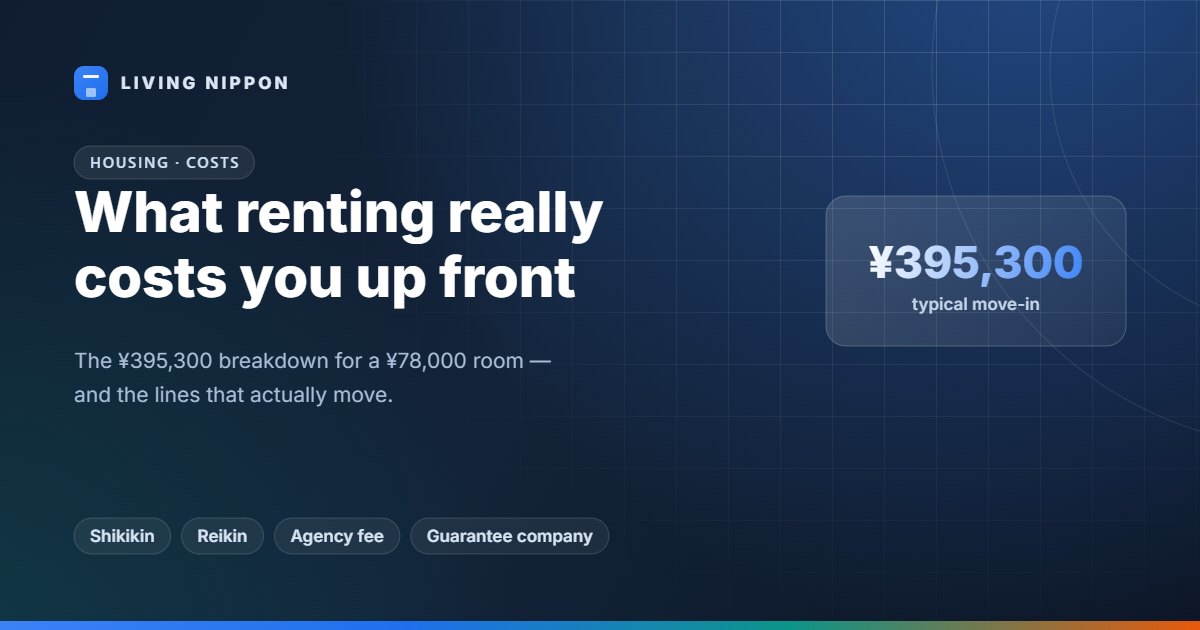
- Worked example: a ¥78,000/month Tokyo room comes to about ¥395,300, itemised below.
- Only reikin (key money), and sometimes the deposit, are negotiable. The rest almost never moves.
- Missing from every quote: koshin-ryo (renewal fee), guarantee renewal, kyoeki-hi (management fee) and the move-out restoration bill.
- What cuts it: zero-zero listings, UR public housing, furnished operators, and avoiding the January-to-March peak.
- Year one runs about ¥1,248,000 on a ¥78,000 lease against ¥506,000 for a ¥38,000 furnished room — though the rooms are not equivalent.
If the deposit is what is blocking you, there is a route without one.
Xross House rents share house rooms and self-contained furnished apartments in Tokyo from ¥38,000/month: no shikikin, no reikin, no agency fee, one flat move-in package of roughly ¥30,000 to ¥50,000. Online applications, ages 18 to 49.

The listing says ¥78,000 a month. Then the agency hands you a sheet with seven lines and a total near ¥400,000, payable in one transfer before you get keys. Nothing on it is a scam, but nothing on it was in the listing either — and reading it a week before your move date is how people pay the high end of everything.
The worked example: ¥78,000 a month, ¥395,300 up front
Every figure here is a typical example, not a quoted price. Initial costs vary by property, landlord, agency and ward; two similar rooms on one street can differ by ¥100,000. Use it to judge whether a quote you have received is normal. The room: a 1K unit at ¥78,000, roughly the 23-ward average.
| Item | Typical basis | Amount |
|---|---|---|
| Shikikin (deposit) | 1 month | ¥78,000 |
| Reikin (key money) | 1 month | ¥78,000 |
| Chukai-tesuryo (agency fee) | 1 month + tax | ¥85,800 |
| Zenyachin (first month in advance) | 1 month | ¥78,000 |
| Kasai-hoken (fire insurance) | 2-year term | ¥20,000 |
| Kagi-kokan-dai (lock change) | flat | ¥16,500 |
| Hosho-gaisha (guarantee company) | 50% of rent | ¥39,000 |
| Total before move-in | about 5.1 months' rent | ¥395,300 |
What each line buys, and which ones move
| Line | What it actually buys | Does it move? |
|---|---|---|
| Shikikin | Security against rent arrears and damage. Refundable in principle, minus cleaning — but some contracts fix a non-refundable share, shikibiki. | Sometimes: two months can become one |
| Reikin | Nothing. A non-refundable gift to the landlord for granting the lease; a postwar custom, not a service. | Yes: the most negotiable line, often waived |
| Chukai-tesuryo | The agency's commission for the viewing and paperwork. Capped by law at one month plus tax. | Rarely: change agency, not the fee |
| Zenyachin | Your first month's rent, brought forward — not a fee. | No |
| Kasai-hoken | Fire and liability cover, mostly protecting the landlord if you flood the flat below. | Rarely: many landlords refuse outside policies |
| Kagi-kokan-dai | A new lock cylinder, so the previous tenant's key stops working. ¥15,000 to ¥22,000 by type. | Almost never |
| Hosho-gaisha | Stands in for a guarantor: if you stop paying it pays the landlord, then collects from you. | Almost never |
Insurance, the lock and the guarantee company are contracts with third parties the landlord already chose — which is why they do not move. On guarantee screening, see renting without a guarantor.
Why "four to six months' rent" is the honest range
The example works out at 5.1 months; five is the figure to plan around. You reach the four-month end when reikin is zero and the deposit is one month — common on older buildings, outlying wards, and off-season: roughly ¥300,000 here. You reach the six-month end with a two-month deposit, two months of reikin and a prepaid cleaning charge on top: past ¥500,000. Most people land between 4.5 and 5.5.
If your quote exceeds six months' rent, ask for the itemisation and look for cleaning charged in advance, a doubled deposit, or a "disinfection" or "pest control" line of ¥15,000 to ¥30,000. Those are usually presented as compulsory and usually are not.
Ask for the written estimate (mitsumorisho) before committing, and read it against the room's advertised terms. A line on the estimate that never appeared on the listing is the one to question.
Five months' rent up front, or one package under ¥50,000.
The advertiser here charges no deposit, no key money and no agency fee. Rooms from ¥38,000/month across 6,000-plus units in the Tokyo area, contracted online. Confirm your figure at the consultation.
The costs that are not in the move-in total
Koshin-ryo (renewal fee). Leases run two years. To renew, most Tokyo landlords charge one month's rent — ¥78,000 here — plus an agency admin fee, often ¥10,000 to ¥20,000, every two years. Not every contract has one; check yours now, not in month 23.
Guarantee company renewal. The initial 50% is not the end: expect an ongoing fee, commonly around ¥10,000 a year, or a small monthly percentage of rent.
Kyoeki-hi (management fee). A monthly charge for common areas — lighting, lift, rubbish — usually ¥3,000 to ¥10,000 and quoted separately, so a "¥78,000" room is often ¥83,000 a month.
The move-out restoration bill (genjo-kaifuku). This is where the deposit goes, and where disputes happen. Government guidelines are clear: normal wear and deterioration over time belong to the landlord, being already priced into your rent. Sun-faded flooring, furniture dents, yellowing wallpaper and pin holes from a calendar are generally not chargeable to you. Your own negligence is: cigarette staining, a mould-blackened bathroom, flooring scratched by dragged furniture, a hole in a wall. Landlords routinely bill beyond what the guidelines support, and you are entitled to an itemised statement and to dispute it — so photograph the apartment the day you move in and the day you leave.
What actually reduces the number
Zero-zero properties advertise shikikin ¥0 and reikin ¥0, stripping two months off. Read the rest of the contract: the cost often reappears as a compulsory cleaning fee at move-out, a cancellation penalty of one to two months if you leave early, or higher rent, and they skew towards older buildings and weaker locations. Cheaper to enter, not always cheaper overall.
UR housing is a public landlord with no reikin, no agency fee, no renewal fee and no guarantor requirement — so no guarantee company fee either. You pay a deposit, usually two months, plus first month's rent, and that is essentially all. The trade-off is qualification: document income of roughly four times the rent, or qualify through savings. Estates are older and further out.
Furnished and share house operators replace the whole stack with one flat package and include appliances — which matters, because an empty Japanese apartment has no curtains, fridge or washing machine, and furnishing one runs ¥100,000 to ¥150,000. See furnished apartments in Tokyo.
Negotiating reikin works at the right moment: when the room has sat listed a long time, when you can move in immediately, and before you apply rather than after. A landlord facing another empty month will often drop it rather than lose you.
Timing. January to March is moving season, when the school and corporate years turn over: rooms go fast and reikin holds firm. The same room in June or November is cheaper to enter.
Actually paying it
The constraint is not the total — it is that the total is due at once, as one bank transfer, in full, several days before the contract date. Keys are released only when it clears, and instalments are not standard.
So the money must be liquid, in Japan, in yen, in an account that can send a domestic transfer, by a fixed date — which trips up more people than the amount does. Without a Japanese bank account yet, sort the paperwork sequence first: see the documents you need to rent an apartment in Japan.
Twelve months, side by side
Move-in cost alone flatters the cheap option; a year is fairer. Using five months' rent for a typical lease and the conservative ¥50,000 package at ¥38,000:
| First 12 months | Typical 23-ward lease at ¥78,000 | Furnished room at ¥38,000 |
|---|---|---|
| Move-in cost | approx. ¥390,000 (5 months, includes month 1 rent) | ¥50,000 |
| Rent thereafter | ¥858,000 (11 × ¥78,000) | ¥456,000 (12 × ¥38,000) |
| Year-one total | ¥1,248,000 | ¥506,000 |
The gap is ¥742,000. It is real, and it is not an equivalent comparison: a ¥38,000 room is small, and in a share house the kitchen, bathroom and laundry are used in common, so you are trading space and privacy for money. Self-contained furnished apartments avoid that trade but cost more. Neither figure includes utilities.
Flat-package operators have limits of their own. The advertiser here accepts applications only from people aged 18 to 49 and only from first-time customers, rooms are in the Tokyo area, and utilities are not published — ask for the monthly total. Both sides in our Xross House review; the wider picture in renting in Japan as a foreign resident.
FAQ
How much should I have saved before I start looking?
For a normal Tokyo rental around ¥78,000, budget about ¥400,000 for the contract plus ¥100,000 to ¥150,000 to furnish an empty apartment — roughly ¥500,000 to ¥550,000 liquid. A furnished route needs far less, but confirm the package and running costs first.
I was quoted ¥520,000 on a ¥78,000 room. Is that normal?
High but within range — about 6.7 months' rent. Ask for the itemisation: it usually means a two-month deposit, two months of key money, or prepaid cleaning. Lines such as disinfection or pest control are often optional despite being presented as standard.
Do I get my deposit back?
Part of it, usually. Cleaning is normally deducted. Beyond that, government guidelines put normal wear and ageing on the landlord — faded flooring, furniture dents and small pin holes should not be charged to you, though damage from negligence can be. Photograph the apartment at move-in and move-out, and ask for an itemised statement of any deduction.
Can I pay initial costs by credit card or in instalments?
Sometimes by card, rarely in instalments. Most agencies want one bank transfer in full before the contract date, keys released once it clears. Assume you need the whole sum liquid in a Japanese account unless told otherwise in writing.
Which fees can I actually negotiate?
Realistically key money, and occasionally the deposit. The agency fee is capped at one month plus tax and changes only if you change agency; insurance, the lock and the guarantee fee are set by third parties the landlord chose. Negotiate before you apply, not after.
Not everyone has ¥400,000 sitting in a Japanese bank account on arrival.
Furnished rooms and self-contained apartments in Tokyo from ¥38,000/month, one flat move-in package of roughly ¥30,000 to ¥50,000: no shikikin, no reikin, no agency fee, and an emergency contact instead of a guarantor. Applications complete online, so it works from overseas. Ages 18 to 49, first-time customers only; confirm the monthly total, as utilities are not published.