- "Furnished" has no standard meaning in Tokyo — anything from a bed and a fridge to a fully kitted room. Get the inventory in writing.
- Furnishing an empty one-room flat new costs ¥130,000–¥300,000, and clearing it out at the end another ¥20,000–¥40,000.
- Over one or two years furnished wins comfortably. Past five or six it stops: furniture is a one-off, a rent premium is forever.
- A furnished apartment is not a share house: these are self-contained one-room or 1K units with their own kitchen and bathroom, some allowing two people.
- Advertised Tokyo rooms run ¥38,000 to ¥109,000, ¥0 deposit and key money. Ages 18 to 49 only.
Move in with two suitcases and nothing else.
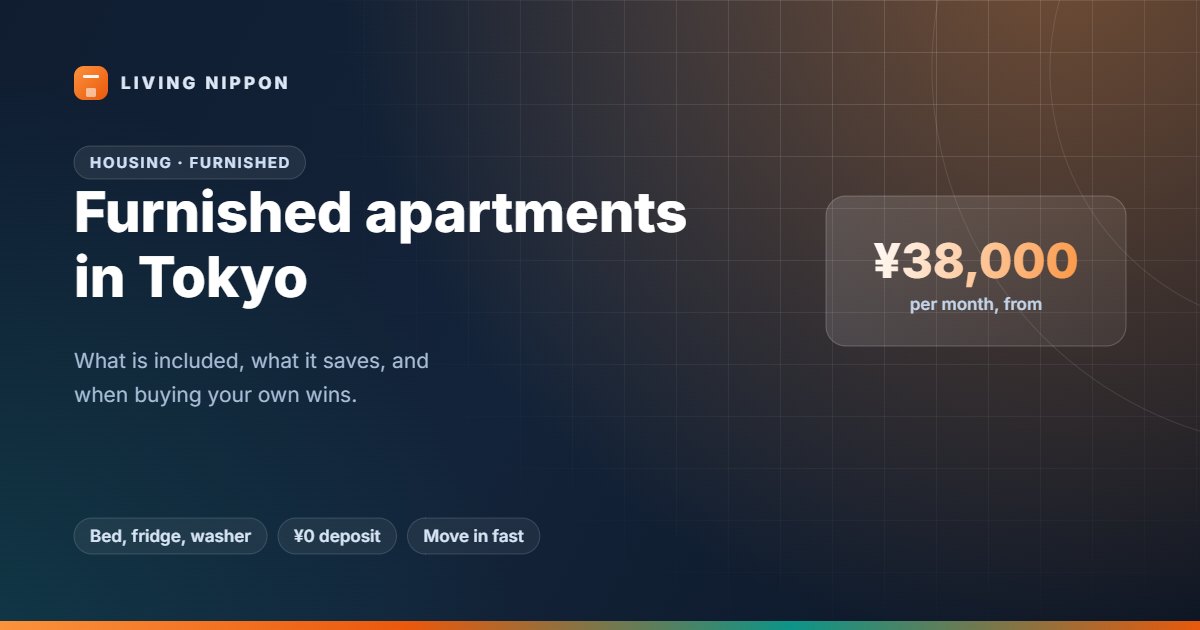
Self-contained Tokyo rooms with bed, fridge, washing machine and air conditioner fitted, from ¥38,000 a month. Ages 18 to 49.

The standard Japanese rental is empty. Not "unfurnished" in the British sense of no sofa — empty. No fridge, no washing machine, no light fittings, sometimes no curtain rail. You bring all of it, and take all of it away again.
For a two-year posting or a first job, that means a fortnight in electronics shops and a four-figure bill at the end for removal. A furnished apartment deletes both — but not the need to check what "furnished" means at that specific property, because the word covers an enormous range.
What "furnished" actually means here
There is no legal definition and no standard package. At the thin end, kagu-kaden tsuki (furniture and appliances included) can mean a bed frame, a small fridge and nothing else. At the full end, a room you can sleep and cook in the night you arrive.
As an example of the fuller end, the operator advertised here supplies as standard: bed, desk, chair, curtains, air conditioner, refrigerator, microwave, washing machine and television. Futon and mattress are extra, rented at ¥1,000 plus tax a month, which over a year costs more than buying one.
Get the inventory in writing before signing, item by item, and ask who pays when an appliance breaks. A listing photo is not a contractual promise.
The maths that decides it
What furnishing an empty room costs
Prices move; treat these as the shape of the bill, not a quote:
| Item | New, budget | Secondhand |
|---|---|---|
| Refrigerator, 100–150L | ¥30,000–¥50,000 | ¥10,000–¥20,000 |
| Washing machine, 5kg | ¥35,000–¥50,000 | ¥12,000–¥20,000 |
| Bed frame and mattress | ¥30,000–¥60,000 | ¥5,000–¥20,000 |
| Microwave | ¥10,000–¥20,000 | ¥3,000–¥8,000 |
| Table, chair, curtains, lighting | ¥20,000–¥45,000 | ¥5,000–¥15,000 |
| Air conditioner plus installation, if none fitted | ¥60,000–¥100,000 | rarely worth it |
Most modern Tokyo rentals already have air conditioning, so realistically ¥130,000–¥200,000 new, or ¥200,000–¥300,000 if you must fit one. Recycle shops, flea-market apps and departing residents' "sayonara sales" bring it to around ¥90,000, at the cost of several weekends and no warranty.
The part people forget: getting rid of it
You cannot leave furniture at the kerb in Japan. Large items go out as sodai-gomi (oversized rubbish): book a collection with your ward in advance, buy a payment sticker at a convenience store, put it out on the assigned morning. Fees run a few hundred to a few thousand yen per item, and slots are often weeks away — worse in March, when the country moves.
Appliances are separate and dearer. Fridges, washing machines, televisions and air conditioners are excluded from sodai-gomi under Japan's home appliance recycling law: a recycling fee plus collection, commonly ¥5,000–¥7,000 each. Clearing a one-room flat lands between ¥20,000 and ¥40,000; ward fees differ, so confirm.
For most people leaving Japan, furniture has a negative resale value. You paid for it, then you pay again to make it go away.
One year and three years, side by side
Compare a ¥68,000 furnished apartment with a typical ¥78,000 flat in the 23 wards. The lease side uses the worked example from our breakdown of initial costs in Japan, ¥395,300, which already includes month one's rent; the furnished side, a ¥50,000 flat initial cost and ¥200,000 to furnish new.
| Furnished, ¥68,000 | Ordinary lease, ¥78,000 | |
|---|---|---|
| Move-in | ¥50,000 | ¥395,300 |
| Furniture and appliances | ¥0 | ¥200,000 |
| Total after 12 months | ¥866,000 | ¥1,453,300 |
| After 36 months, with disposal | ¥2,498,000 | ¥3,355,300 |
That is ¥587,300 in year one and ¥857,300 over three, before the renewal fee of about a month's rent a lease adds at two years.
Now be fair to the other side: cheaper rent is baked into that. Take a furnished room costing more than the alternative — ¥83,000 in Nishi-Shinjuku against a ¥78,000 ordinary flat. On rent and move-in alone the lease catches up a little over four years in. Add ¥90,000 of secondhand furniture and ¥25,000 of disposal to its side and the crossover moves to roughly six and a half years; furnish new and it is nearer eight.
The principle: furnishing is a one-off, a rent premium never stops. For one or two years furnished is hard to beat. For a decade it is not the answer — and the 18-to-49 age limit means it cannot be a permanent plan anyway.
Run the numbers on a real room, not an average one.
Listings show rent, nearest station and what comes with the room.
Compare furnished rooms and rents
A furnished apartment is not a share house
This is the distinction most English-language articles get wrong. Both products often come from the same operator, which is where the confusion starts.
| Furnished apartment | Share house | |
|---|---|---|
| Layout | Self-contained one-room or 1K unit | Private or shared room in a larger house |
| Kitchen, bath, toilet | Your own, inside the unit | Shared with other residents |
| Cleaning | Yours | Common areas cleaned by a service |
| Occupancy | Single; some properties allow two | Single |
The familiar complaints — queuing for the shower, someone else's food in your fridge — belong to the second column only. If you have read that this housing means no privacy, that was the other product; our review of the operator behind both takes each on its own terms.
What furnished gets you beyond the furniture
The furniture is often not the main saving. Three other things come with it.
No deposit or key money. Shikikin (a deposit, rarely refunded in full) and reikin (key money, a non-refundable gift to the owner) are both ¥0 here, as is the agency fee. You pay one flat initial cost package instead, roughly ¥30,000–¥50,000 by property and plan. No guarantor is required, though an emergency contact is.
Speed. Application and contract are done online, so you can secure a room from abroad instead of paying for a hotel. Minimum stay is one month despite the one-year contract, and you can leave on a month's notice — see our guide to short-term monthly rentals in Tokyo.
Free transfers inside the network. Moving to another of the operator's properties costs ¥0 out and ¥0 in, including across regions such as Tokyo to Osaka. On the open market that means paying initial costs again from scratch. If your job might relocate you, this is quietly the biggest number here.
Where the rooms are, and what they cost
Rent buys location, and the spread is wide. Four real Tokyo examples:
| Property | Rent | Where |
|---|---|---|
| Terrace Higashi-Kurume | ¥38,000 | Seibu Ikebukuro Line, about 30 minutes out |
| Maison de Madrier | ¥68,000 | Setagaya-Daita, inner west Tokyo |
| Luce Nishi-Shinjuku | ¥83,000 | Nishi-Shinjuku, central |
| Neo Tokyo Annex | ¥109,000 | Near Shinagawa |
The gap between cheapest and dearest is ¥71,000 a month, and almost all of it is commuting time. A small 23-ward apartment rents from about ¥78,000, so the ¥38,000 and ¥68,000 rooms are genuinely cheap housing, while at ¥83,000 and ¥109,000 you are buying furniture, a central address and zero move-in cost, not cheap rent. Know which trade you are making.
Service fees and utilities are not published for these rooms. Electricity, gas, water, internet and any common charge could add meaningfully to the rent shown. Ask for the all-in monthly figure in writing, and compare that.
Who furnished apartments do not suit
People settling in Japan long term. Past five or six years the arithmetic turns over, and you will want a flat you can furnish to your own taste.
Families with children. These are one-room and 1K units. Some permit two occupants, so a couple is not ruled out — ask which — but a family is.
Anyone aged 50 or over. This operator accepts ages 18 to 49 only. A hard eligibility rule, not a preference.
People needing an area it does not cover. Coverage is concentrated in Tokyo and a few other regions; outside those, the free-transfer advantage disappears too.
People who own furniture they like. If you already have a fridge and a bed, you are paying for something you do not need. If agencies keep refusing you outright, that is a different problem — see renting in Japan as a foreign resident.
FAQ
Is a furnished apartment in Tokyo more expensive than a normal one?
Per month, often slightly. Over the first year, almost never: you avoid move-in costs on the scale of ¥395,300 plus ¥130,000–¥300,000 of furniture. An ordinary lease catches up past the four-to-eight-year mark, depending on how cheaply you furnish.
What is included, and what is not?
At this operator: bed, desk, chair, curtains, air conditioner, refrigerator, microwave, washing machine and television. Futon and mattress are a ¥1,000 plus tax monthly rental. Cookware, crockery and bedding are yours to buy. Packages vary hugely, so confirm item by item.
Do I have to share a kitchen or bathroom?
Not in a furnished apartment. These are self-contained one-room or 1K units with their own kitchen and water facilities. Sharing applies only to share houses, a separate product.
What does it cost to throw furniture away when I leave?
For your own furniture, budget ¥20,000–¥40,000 for a one-room flat. Large items need a sodai-gomi collection booked ahead with a paid sticker; appliances fall under a separate recycling scheme at roughly ¥5,000–¥7,000 each. In a furnished room it is zero.
Can two people live in a furnished apartment?
Some properties allow two occupants and some do not, so raise it before you shortlist. Children are different: these are not family housing.
Get the inventory and the all-in monthly cost before you decide.
The online consultation is free, runs in your language including at weekends, and needs no office visit.
Start a free online consultation