- A normal Japanese lease runs one to two years and costs four to six months' rent to start — about ¥395,300 on a ¥78,000 room. Over three months that is roughly ¥130,000 a month in fees alone, before rent.
- Four realistic alternatives: monthly mansions, share houses and furnished rooms with a one-month minimum, business hotels and apart-hotels, and minpaku (private lodging) via booking platforms.
- Minpaku is capped at 180 nights of operation per year per property under the Housing Accommodation Business Act — which is why listings refuse long bookings or vanish mid-stay.
- Over three months: roughly ¥165,000–¥290,000 for a furnished room, ¥390,000–¥600,000 for a monthly mansion, ¥600,000 and up for a hotel. Typical ranges, not quotes.
- The bridge that works: take a short-term room, register your address, open a bank account, gather income documents, then apply for a normal lease from strength.
Need a Tokyo room for a few months, not a few years?
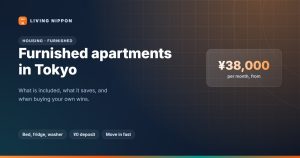
Furnished rooms from ¥38,000 a month, stays from one month, a flat move-in package of roughly ¥30,000–¥50,000. No deposit, no key money, no guarantor. Ages 18 to 49.

You need somewhere in Tokyo for one to six months — a working holiday, a language school term, a project posting, or a place to sleep while you hunt for a proper flat. You have been searching rental sites and the numbers make no sense, until you realise the market you are looking at was never built for you.
Why the normal rental market cannot serve you
A standard Japanese lease is a two-year contract, occasionally one year, priced on the assumption that you will stay. The move-in bill runs four to six months' rent. On a ¥78,000 room — around the Tokyo 23-ward average — a realistic total is ¥395,300: deposit (shikikin) ¥78,000, key money (reikin, a non-refundable gift to the owner) ¥78,000, agency fee ¥85,800, first month's rent ¥78,000, fire insurance ¥20,000, lock change ¥16,500, guarantee company fee ¥39,000.
Only the deposit is refundable, and only after cleaning and repair charges, months after you leave. The rest is gone the day you sign. Spread ¥395,300 across three months and you are paying roughly ¥130,000 a month in fees alone, before a single yen of rent. Even over six months it is ¥65,000 a month.
Leaving early costs more still: many leases carry a penalty of one to two months' rent, with one to two months' notice required. And you would be furnishing an empty room — Japanese flats come with no bed, no fridge, no washing machine, no curtains, often no light fittings. Our breakdown of initial costs walks through every line.
The four realistic options
Monthly mansions
Built for stays of one to twelve months. Furnished, linen included, utilities and internet usually bundled into one figure, and priced per night with the rate falling the longer you book. Expect a cleaning fee of ¥20,000–¥40,000 on top. Best for one to three months when you want your own front door and zero setup. The catch is the premium: per night it sits far above what the same room would let for on a normal lease, and short bookings are the worst value.
Share houses and furnished rooms, one-month minimum
Operators who own or master-lease their stock and rent by the room. Furniture, appliances and often internet are included, and the move-in payment is a flat package rather than five separate fees. Two formats, not the same thing: share houses, where kitchen and bathroom are shared, and self-contained furnished apartments — one-room or 1K units with their own kitchen and bathroom. Cheapest per month on this list, and the format that scales best from one month to six. See our guide to furnished apartments in Tokyo.
Business hotels and apart-hotels
No paperwork beyond a passport, bookable tonight, cancellable tomorrow. That flexibility is the whole product, and it is why the nightly rate compounds so brutally: a modest ¥8,000 a night is ¥240,000 a month. Apart-hotels with a kitchenette and a monthly rate soften this considerably. Sensible for your first week or two while you view rooms; a poor plan for month three.
Minpaku through booking platforms
Private lodging — minpaku — looks ideal: furnished, no screening, bookable from abroad. There is a hard legal limit. Under the Housing Accommodation Business Act (the minpaku law, in force since June 2018), a registered private lodging may operate a maximum of 180 nights per year, per property. Many Tokyo wards restrict it further by season or zone.
That cap is why minpaku is unreliable beyond a few weeks. Hosts ration their nights and refuse long bookings, listings vanish when a host runs out of allowance, and a cancellation two months in leaves you moving with a week's notice. Unlicensed listings can be shut down without warning.
What three months actually costs
Typical market ranges for one person in Tokyo — not quotes. Confirm every figure with the provider before committing.
| Option | Up-front | Three months, total | Effective per month |
|---|---|---|---|
| Standard lease, ¥78,000 room | ~¥395,300 | ~¥551,300 | ~¥184,000 |
| Monthly mansion | ¥20,000–¥40,000 cleaning | ¥390,000–¥600,000 | ¥130,000–¥200,000 |
| Share house / furnished room | ¥30,000–¥50,000 | ¥165,000–¥290,000 | ¥55,000–¥97,000 |
| Business hotel | None | ¥600,000–¥1,000,000 | ¥200,000–¥330,000 |
| Apart-hotel, monthly rate | Usually none | ¥450,000–¥750,000 | ¥150,000–¥250,000 |
| Minpaku | Platform fees | ¥300,000–¥700,000 | ¥100,000–¥235,000 |
The standard lease is the most expensive way to spend three months in Tokyo — and the only one that also demands a guarantor and a two-year commitment.
One month minimum, contract signed online before you fly.
Over 6,000 managed rooms across the Tokyo area: share houses and self-contained furnished apartments. Multilingual support in 12 languages, open weekends and public holidays.
Start a free online consultation
The paperwork difference
Cost is only half the reason people end up here. A normal lease requires a guarantor (hoshonin) or a guarantee company that screens your income, visa period, employer and phone number — and that screening is where many foreign applicants are refused. Short-term options largely skip it.
What you still need, in almost every case: passport and residence card, a contact number and email, and an emergency contact — someone to call in a crisis, not someone who pays your rent. Longer furnished-room contracts may ask for proof of income or enrolment, and payment usually needs a Japanese bank account or a card. Our document checklist covers what each item is called.
The bridge strategy that actually works
If your real goal is a normal flat and you are short-term only because you have just arrived, do it in this order rather than fighting for a lease from a hotel room.
- Take a short-term room first. One month, furnished, no guarantor. You now have an address.
- Register that address at the ward or city office within 14 days and get a residence certificate (jumin-hyo). Nearly everything else depends on it.
- Open a bank account and get a phone number in your own name — both are near-mandatory on a lease application.
- Collect income documents: a certificate of employment (zaishoku shomeisho), pay slips, or a school enrolment certificate.
- Then apply, with months of residence history behind you. A guarantee company reads that file very differently from one with a hotel in the address box.
For the wider picture, start with our guide to renting in Japan as a foreign resident.
Where the advertised operator fits — and what it is not
The operator advertised here runs share houses and self-contained furnished apartments in Tokyo, with rooms from ¥38,000 a month and a flat move-in package of roughly ¥30,000 to ¥50,000 — no deposit, no key money, no agency fee. No guarantor, only an emergency contact. Application and contracting are handled entirely online, so a room can be arranged before you fly. Rooms include a bed, desk, chair, curtains, air conditioner, fridge, microwave, washing machine and television; bedding is rented separately at ¥1,000 a month plus tax. Later transfers between properties cost ¥0.
Be clear about what it is not. The contract is a one-year contract you can leave early, not a one-month product. The minimum stay is one month and you may cancel with one month's notice — so read the cancellation terms yourself and confirm what happens if you leave in month two. Applicants must be 18 to 49 years old, this is Tokyo only, share houses genuinely share kitchen and bathroom, and common-area and utility charges are not published. Ask for the total monthly figure in writing at the online consultation.
FAQ
Can I book a Tokyo room from overseas before I arrive?
With monthly mansions and furnished-room operators that contract online, yes — it is a normal way they do business, and some can finish everything before you land. A standard lease is far harder from abroad, because screening expects a Japanese address, phone number and often a bank account.
Can I register my address at a short-term room?
Usually yes for a monthly mansion or a furnished room let on a residential contract — confirm it in advance, because your bank account, health insurance and phone contract all depend on it. A hotel is not a residence, and a minpaku generally will not work either.
Why do minpaku hosts refuse a three-month booking?
Because a registered private lodging may operate only 180 nights a year per property, and one long guest eats half the host's annual allowance. Some Tokyo wards cut the permitted period further. It is a legal ceiling, not a preference, so negotiating rarely helps.
Which is cheapest for exactly six months?
A furnished room or share house, by a wide margin: small one-off move-in cost, monthly rent close to market. A standard lease only starts to compete past a year, and only if you stay long enough to recover the ¥395,300 you paid at the door.
What if I have to leave after two months?
Check the notice period before you sign, not after. Monthly mansions are often booked and paid by the period, so early departure may not be refunded. Furnished-room operators typically want one month's notice. That single clause is the most important thing in any short-term contract.
Somewhere to land while you sort out the rest.
Tokyo share houses and furnished apartments, stays from one month, cancellable on one month's notice. No deposit, no key money, no guarantor — an emergency contact instead. Ages 18 to 49.
Check rooms and book a consultation