- A residence card is accepted as photo ID by Wise in Japan, for permanent residents and for mid-to-long-term residents alike.
- Submitting your My Number is mandatory and is a separate step from photo ID. Three forms of evidence are accepted.
- Your name, date of birth and address must match exactly across your photo ID, your My Number document and your Wise profile. This is where most applications stall.
- You can fund with a bank transfer or a debit card. Credit cards, cash, and payments from anybody else's account are refused.
- Salary, bonus and cryptocurrency-exchange proceeds are refused as a source of funds, which catches people trying to remit their pay directly.
- The Wise debit card is issued to residents of Japan. Older articles saying otherwise are out of date.
You have probably heard that Wise is cheaper than sending money through a Japanese bank. The more useful question, if you are a foreign resident here, is whether you can actually open and use an account at all. Plenty of guides skip straight to the fee comparison and never say which documents Japan-based users have to hand over, what happens when the name on your residence card is not quite the name on your bank account, or which sources of money Wise will simply refuse to accept. This article covers the account-opening path end to end: eligibility, identity verification, the My Number step, the exact-match rule that trips people up, and the funding rules that decide whether your verified account is actually usable.
First, what Wise is in Japan
Wise is operated in Japan by Wise Payments Japan K.K., based in Chuo-ku, Tokyo. It is registered with the Kanto Local Finance Bureau as funds transfer service provider No. 00040, registered on 18 August 2015, and it holds both Type 1 and Type 2 funds transfer registrations, the Type 1 registration having been obtained in March 2024.
That registration matters for one reason above all: Wise is not a bank. It is a funds transfer service provider. Nothing in this article should be read as saying you are opening a bank account, and you should not expect bank-account behaviour from it. What you are opening is an account with a regulated payments company that can hold a limited balance and move money abroad.
Who can open an account with a residence card
Wise publishes a page specifically for verification in Japan, and it is the one you should follow. The accepted photo ID depends on your residence status.
| Your status | Photo ID accepted |
|---|---|
| Japanese national | My Number card (preferred), driving licence, or a Japanese passport issued before February 2020 |
| Permanent resident | My Number card, driving licence, or residence card |
| Mid-to-long-term resident | My Number card or residence card |
The headline for most readers of this site is in the second and third rows: the residence card is accepted, and it is accepted both for permanent residents and for mid-to-long-term residents. You do not need to obtain a Japanese driving licence or a My Number card first in order to be verified as a photo-ID matter. If you are on a work visa, a student visa, a dependent visa or any other mid-to-long-term status and you hold a residence card, that card is a valid photo ID for this process.
Wise's general Japanese-language help pages are localised versions of its global content, and they do not mention the residence card. That has led some readers to conclude the card is not accepted. Use the Japan-specific verification page instead, which does list it.
My Number is mandatory, and it is a separate step
Submitting your My Number (the individual number issued to every resident of Japan, including foreign residents) is required. It is not optional, and it is not covered by uploading your photo ID. Treat it as a second document step that comes after the first.
Three forms of evidence are accepted:
- Your My Number card.
- Your notification card.
- A certificate of residence showing your My Number, issued within the last six months.
There is one shortcut. If you used your My Number card itself as your photo ID, the back of the card already carries the number, so this step is skipped. Everyone verifying with a residence card or a driving licence will need to supply My Number evidence separately.
Practically, this means a resident who has never picked up a My Number card and has misplaced the notification card should go to their city or ward office and request a certificate of residence with the number printed on it. Ask explicitly for the version that includes My Number, because the default printout often omits it. Note the six-month window: an old certificate sitting in your file drawer may no longer qualify.
The requirement that actually causes failures: everything must match exactly
This is the part to slow down on. Wise requires that your name, date of birth and address are an exact match across three places at once:
- Your photo ID (the residence card, driving licence, or My Number card).
- Your My Number document.
- The profile you filled in on Wise.
Three documents, three fields, one consistent answer. It sounds trivial and it is not, because in Japan these three sources are produced by different offices at different times and drift apart quietly.
The most common ways they drift:
Name order and middle names
A residence card prints your name as it appears in your passport, which for many nationalities includes a middle name, a compound surname, or a name order that a web form does not expect. If your card shows a middle name and your Wise profile does not, they do not match. Enter the name exactly as printed on the ID you are submitting, including every given name, in the same order.
Addresses that were never updated
You moved, you updated your residence card at the ward office, and the reverse side now shows the new address. Did you also update it on Wise? And does the My Number certificate you are about to upload show the new address or the old one? A certificate of residence pulled after your move will show the current address; a notification card from years ago will show whatever was true then. If the documents disagree, the application stalls.
Date of birth format
Documents issued in Japan often use the Japanese era calendar, while your passport and residence card use the Gregorian one. The underlying date is the same; make sure the date you type into Wise is that same date and not a transcription slip.
There is a related problem that this article deliberately will not try to solve for you: residence cards print your name in the Latin alphabet, while a Japanese bank account is usually registered in katakana. Neither Wise nor any Japanese regulator publishes guidance on how a script mismatch between the two should be handled, so any step-by-step fix you read online is somebody's guess. What is documented is only this: Wise requires the name, date of birth and address to match exactly. If you hit this wall, ask Wise support and your bank directly rather than following improvised advice.
One more point on prerequisites. Wise does not state anywhere that a Japanese bank account is mandatory to open an account. In practice you will almost certainly need one, because funding has to come from an account in your own name and because the balance you can hold is capped. Treat a Japanese bank account as effectively necessary, even though it is not formally listed as a requirement.
Before you gather documents, check what your own transfer would cost.
The cost of a transfer depends on the amount and the destination currency, so a general comparison tells you very little. Put your own figure in and compare it against what your bank quotes you for the same amount on the same day.
Funding the account: what works and what is refused
A verified account you cannot put money into is useless, so read this section before you start. From Japan, the options are narrower than most people assume.
| Method | Accepted? | Notes |
|---|---|---|
| Bank transfer (ATM or internet banking) | Yes | The main method. Up to two business days. PayPay Bank transfers are often close to instant, around the clock. |
| Debit card | Yes | Fast. If a payment is refunded, expect five to ten business days. |
| Credit card | No | Explicitly refused. |
| Cash | No | Not accepted. |
| Payment from someone else's account | No | Funds must come from an account in your own name. |
Two consequences worth spelling out. First, a household that runs everything through one partner's bank account cannot simply pay from that account into the other partner's Wise account; the name has to be the account holder's own. Second, whether a bank transfer and a debit card payment cost the same is not something Wise publishes, so do not assume one is cheaper than the other.
The trap: salary, bonus and crypto proceeds are refused as a source of funds
This one deserves its own section because it defeats the single most common plan foreign residents arrive with: get paid, then send the pay home.
Wise refuses salary and bonus payments as a source of funds, and it refuses withdrawals from cryptocurrency exchanges. That is a rule about where money comes from, not about how much you send. If you were imagining your employer paying into Wise directly, or planning to route your monthly pay straight through, that route is closed.
What this leaves is the ordinary path: your salary is paid into your Japanese bank account, as it normally would be, and you then fund Wise from that account by bank transfer or debit card in your own name. Likewise, if you have been trading cryptocurrency, money coming directly out of an exchange is not an acceptable source here.
If you are still deciding which service to use and your plan depends on remitting your pay the moment it lands, factor this in before you open anything. Our overview of how to send money home from Japan walks through the alternatives, and the documents you need to send money abroad from Japan covers what other providers ask for.
Where your money actually goes: financial institution code 0200
When you fund by bank transfer, the destination will not look like a familiar bank, and this surprises people at the ATM.
Wise Payments Japan is a direct participant in the Zengin system, Japan's domestic interbank transfer network, with financial institution code 0200. So the transfer destination is a company name, Wise Payments Japan, rather than the name of a bank you recognise. There is nothing wrong with the instructions if that is what you see: it is what a direct Zengin participant that is not a bank looks like from the sending side.
Some ATMs display the destination as "Wise Payments Japan Bank". Wise treats that as a known display error. The company is not a bank, and the word appearing on an ATM screen does not make it one. Follow the transfer details Wise gives you exactly, including the reference number, and do not adjust the recipient name to match what a screen shows you.
What your account can do once it is open
Verification gets you in. Knowing the shape of what you have got avoids disappointment later.
The debit card is available. The Wise debit card is issued to residents of Japan, which is worth stating plainly because a number of older articles still claim it is not. We are not relying on the country list alone here: we have used a Wise card for a card payment in Japan ourselves, in February 2025. It is subject to the same balance ceiling as everything else in your account.
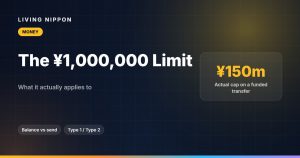
Balance and transfer limits are different things. The widely repeated line that "Wise in Japan is capped at one million yen" is a misreading. The one-million-yen ceiling applies to the balance side: holding a balance, topping it up, sending from it, and withdrawing from it are each limited to ¥1,000,000 or the equivalent per transaction. A transfer funded from outside by bank transfer or debit card can go far higher, up to the equivalent of ¥150,000,000 per transaction. Transfers above one million yen are switched by Wise onto its Type 1 registration automatically; you do not apply for anything or split the payment yourself. The balance holding limit can be raised to ¥20,000,000 on request for a maximum of six months, and if you exceed the holding limit you get a thirty-day grace period during which transfers and card payments continue to work. We go through this in detail in what Wise's ¥1,000,000 limit in Japan actually applies to.
Receiving money in Japan is the weak spot. Wise issues JPY account details for receiving, but they are SWIFT-only rather than domestic Zengin details, and incoming transfers of ¥1,000,000 or less cannot be processed through them. If someone abroad wants to send you a modest amount, give them your Japanese bank account instead; it will be faster and cheaper. And because a Japan-based user hits the one-million-yen holding ceiling quickly, the account is structurally not built for receiving. See receiving money from abroad in Japan for the alternatives.
That limitation runs in one direction only, so do not over-read it. The ¥1,000,000 floor applies to Wise's SWIFT yen receiving details, meaning money pushed at your account from abroad. Paying yen out of a Wise balance into a Japanese bank account is a different operation, and it works normally, including for small amounts. We have done that ourselves. So "Wise cannot handle small yen amounts in Japan" is the wrong conclusion: receiving small yen amounts into the SWIFT details is what does not work.
What it costs, as quoted on 16 August 2026
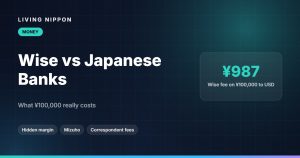
To make the account concrete: sending ¥100,000 out of Japan, the total fee quoted on 16 August 2026 was ¥987 to USD, ¥878 to EUR, ¥921 to GBP, ¥1,027 to INR, ¥1,078 to PHP, ¥1,244 to VND, ¥1,310 to KRW, ¥1,794 to NPR and ¥1,833 to CNY. These are live quotes captured on that date, not a published price list, and they will not be the numbers you see today.
One structural point does hold up beyond the snapshot. On the same date, the exchange rate applied to a ¥100,000 transfer to USD and to a ¥500,000 transfer to USD was identical, meaning the cost sat entirely in the stated fee rather than being buried in the rate. That is the specific claim Wise makes about itself, and it is the thing to test when you compare: a bank's headline fee is not its total cost, because most Japanese banks do not publish the margin built into their exchange rate. Our side-by-side of what ¥100,000 really costs through Wise versus Japanese banks goes through that comparison properly. One extra item to know about: sending from a JPY balance via SWIFT carries a separate fixed cost of ¥181.75.
Rates and fees move. Whatever you read here, quote your own amount to your own destination on the day you send, and quote the same amount at your bank, before deciding.
FAQ
Can I open a Wise account with only a residence card?
The residence card is accepted as photo ID for both permanent residents and mid-to-long-term residents. You will still need to supply My Number evidence separately, unless you verified using a My Number card as your photo ID.
I do not have a My Number card. Can I still get verified?
Yes. A notification card or a certificate of residence showing your My Number, issued within the last six months, is also accepted.
Do I need a Japanese bank account?
Wise does not state that one is mandatory. In practice it is close to necessary, because funding must come from an account in your own name and cash is not accepted.
Can my employer pay my salary straight into Wise so I can send it home?
No. Salary and bonus payments are refused as a source of funds, as are withdrawals from cryptocurrency exchanges. Have your pay go to your Japanese bank account first, then fund Wise from there.
Can my husband or wife pay from their account into my Wise account?
No. Payments from a third party are rejected. The funding account has to be in your own name.
Why does the transfer destination show a company name instead of a bank?
Wise Payments Japan is a direct participant in the Zengin system with financial institution code 0200, and it is a funds transfer service provider rather than a bank. Some ATMs display it as "Wise Payments Japan Bank", which Wise treats as a known display error.
Is the Wise debit card available in Japan?
Yes, the card is issued to residents of Japan. Articles saying it is unavailable here are out of date. The ¥1,000,000 balance ceiling still applies.
Is there an amount at which I have to report a transfer to the Japanese authorities?
Under the Foreign Exchange and Foreign Trade Act, the reporting obligation applies to payments and receipts exceeding the equivalent of ¥30,000,000. Amounts at or below that do not require the report.
Get your documents in order first, then compare on the amount you actually send.
Line up your photo ID, your My Number evidence and your Wise profile so the name, date of birth and address are identical on all three. Then run a quote for your own amount and currency and put it next to your bank's total for the same day.