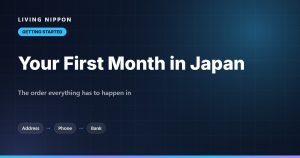
- None of these steps are independent. The zairyu card (residence card) unlocks address registration, address registration unlocks most contracts, a phone number unlocks the bank account application, and a bank account unlocks almost every home internet contract. Do them out of order and you get turned away at a counter.
- A Japanese credit card is not the only way to pay a phone bill. Debit cards and furikomi (automatic payment taken from your bank account) are listed as accepted by at least one major carrier, although whether your specific card or account is accepted is decided case by case.
- If your residence card is the newer tokutei zairyu card, which merges the residence card and the My Number card into a single card, some smartphone identity checks do not accept it and you may have to apply in a shop instead.
- Where you live changes the order. In a company dormitory or a share house, WiFi is often already provided and home internet is not urgent, but a phone number and a bank account in your own name still are.
- No-installation WiFi is a genuine shortcut for people without a bank account or without a settled address, but it is a shortcut with limits, not a permanent substitute for a fixed line.
- This article answers one question only: what to do first, and why. Three companion articles cover the bank account, the phone contract and the WiFi options in detail.
In your first few weeks in Japan you will be told, by well-meaning people, to sort out a SIM card, open a bank account and get internet at home. What almost nobody tells you is that these three things are not a to-do list you can work through in any order. They are a chain. Each one is a precondition for the next, and the moment you try to do them backwards you end up standing at a counter with a form you cannot complete.
This is the article that draws that chain. It does not explain how to open a specific account or how to choose a specific plan, because three separate articles do that. It explains the sequence: what unlocks what, where the sequence changes depending on whether you live in company housing or in your own place, and which two things about that sequence are actively changing in 2026 and therefore need checking rather than trusting.
The dependency chain: what unlocks what
Five things, in order. The order is not a suggestion, it is how the paperwork actually works.
1. The zairyu card (residence card). This is the document everything else is built on. For most mid-to-long-term statuses of residence it is issued at the airport on arrival, or at a regional immigration office shortly afterwards. Without it you cannot register your address at city hall, you cannot open an account at any Japanese bank, and you cannot sign a phone or internet contract in a shop. If you are still waiting for it, the honest answer is that you are waiting, and there is very little you can usefully do in the meantime.
2. Address registration at city hall. Within 14 days of moving into a place to live, the law requires you to report your address at the municipal office for the area where you live. This is the step that creates your official address inside the Japanese administrative system and produces the juminhyo (certificate of residence) that other institutions ask for. It also matters in a very practical way: that registered address is where a carrier posts your SIM card, where a bank posts your cash card, and where a WiFi provider ships your router. If the address on your contract does not match the address the delivery system knows about, things get returned.
3. A Japanese phone number. Almost every application after this point has a field for a mobile number, and many of them send a verification code to it. A number from home does not work for this. This is the reason a SIM is worth arranging early, even if you are living somewhere with WiFi already and feel no urgency about data.
4. A bank account. This is the step most people underestimate, because they think of a bank account purely as a place to receive salary and send money home. In the telecoms chain it does something else: it is the payment instrument. Home internet providers and mobile carriers overwhelmingly bill monthly by card or by automatic transfer from an account. They do not take cash every month. No account and no card means, in most cases, no contract.
5. Internet at home. Last, because it depends on all four of the above and, for a fixed line, on your landlord as well.
The table: what you cannot do without what
| What you want | What you need first | What usually blocks people |
|---|---|---|
| Register your address | Zairyu card, a place to live | Doing it later than 14 days after moving in |
| Mobile line | Zairyu card, registered address, a payment method | Assuming a credit card is compulsory |
| Bank account | Zairyu card, registered address, Japanese phone number | Rules tied to how long you have been in Japan |
| Fixed home internet | All of the above, plus the landlord or building | Bill payment method, and building restrictions |
| No-installation WiFi | A payment method, a delivery address | Most providers accept credit cards only |
Read that middle column downwards and the shape of the problem becomes obvious. Every row after the first needs the rows above it. That is the whole argument of this article.
Where you live changes the order
If you are in a company dormitory or share house
Shared accommodation very often comes with WiFi already installed, which removes the most expensive and slowest item from your list. That is genuinely good news, and it means you should not spend your first month worrying about fixed-line internet at all.
What it does not remove is the need for a phone number and a bank account in your own name. Shared WiFi belongs to the building, not to you. It disappears the day you move out, it cannot be used to verify your identity, and it is not a payment method. People who lean on dormitory WiFi and postpone everything else tend to discover the problem at the worst moment, which is when they are moving into their own place and suddenly need a phone number, a bank account and a new internet contract in the same week.
If shared WiFi is slow or unreliable in your room, a no-installation WiFi router is a reasonable stopgap, and it is the one telecoms product in this whole cluster that does not require a landlord's permission.
If you have your own apartment, or will soon
Here the full chain applies, and one extra dependency joins it: the building. A fixed fibre line may require the owner's consent, and in some buildings the equipment is already in place and in others it is not. That is a question for the property, not for the provider, and it is worth asking before you sign anything, alongside the other paperwork the rental process demands. Our guide to the documents a Japanese rental asks for covers the same deadlock from the housing side, because the address, the bank account and the phone number tangle up there too.
The practical consequence is timing. Fixed internet is the item with the longest lead time and the most parties involved, so start it early even though it comes last in the chain, and plan to cover the gap with mobile data or a rented router.
Phone: settle the SIM before you worry about home internet
A mobile line is the cheapest and fastest way to become contactable, and being contactable is what the next three steps need. Treat it as infrastructure rather than as a consumer purchase.
Two things decide whether an application goes through: how you will pay, and how you will prove who you are.
On payment, the widespread belief that you need a Japanese credit card is not accurate as a blanket statement. At least one major carrier publishes debit cards and automatic bank transfer among its accepted payment methods, and the list of banks it works with for automatic transfer is long. The caveats are real and we spell them out in the Rakuten Mobile guide, including one point the official pages do not answer: whether foreign nationals can rely on automatic bank transfer is not stated anywhere official, so nobody should promise you that it will work.
On identity, there is a specific trap worth knowing about before you spend an evening on an application. Online sign-up normally works by reading the IC chip in your residence card with your phone. If you hold a tokutei zairyu card, the version that combines the residence card and the My Number card into one card, that smartphone check is not available for at least one major carrier and you have to apply in a shop. The same change has had knock-on effects at banks. If you have the merged card, plan on going somewhere in person and take your documents with you.
The bank account sits in the middle of the chain, not at the end
The mistake is to treat the account as the last errand, something to do once life has settled down. In the sequence above it is item four out of five, and item five depends on it.
It is also the step with the most conditions attached, and the conditions differ by bank rather than by any single national rule. Some banks apply requirements tied to how long you have been in the country. Some care about how much validity is left on your residence card. At least one bank changed its verification process during 2026 in response to the new merged card and moved parts of the process to post. These are the kinds of details that decide whether your application succeeds on the first attempt, and they are exactly what the bank account guide sets out bank by bank, along with what a debit card does and does not do compared with a credit card.
One thing worth separating in your head: opening an account and moving money abroad are different problems with different rules. Getting the account is about identity and residency. Sending your money home afterwards is about cost and documentation, which is a separate subject covered in the guide to sending money from Japan.
Internet at home: fixed line or no-installation WiFi
There are two families of answer, and choosing between them is mostly a question about your situation rather than about speed.
A fixed line is the right answer if you are staying in one place for a while, you have a bank account or card to pay with, and your building allows it. It is the option that involves the most other people: the provider, the building owner, and sometimes an engineer visit.
No-installation WiFi, meaning a pocket router or a plug-in home router that arrives by post and works out of the box, is the right answer if any of the following are true: you do not have a bank account yet, you do not know how long you will stay at this address, your building will not permit installation work, or you simply need something working this week. The trade-off is that most providers in this category accept credit cards only, contract terms and device costs vary a lot, and the equipment usually has to go back or be paid off if you cancel early. Which providers accept what, and specifically which one accepts payment from a bank account rather than a card, is the whole subject of the no-installation WiFi comparison.
If you are between homes, or on a short posting, do not sign a long fixed-line contract to cover a few months. Cancellation costs and leftover device payments are where short-stay residents lose money in this category, and they are avoidable by choosing a product with no minimum term in the first place.
Two things that are changing right now
Most of the chain above is stable. Two parts of it are not, and both deserve to be checked rather than assumed.
The merged residence card. The tokutei zairyu card, which combines the residence card and the My Number card, is not accepted by every smartphone-based identity check. One major carrier states plainly that its quick smartphone verification cannot be used with it, which means a shop visit. At least one online bank suspended smartphone verification and IC chip reading for account opening after the merged card was introduced in June 2026 and switched to handling applications by post for the time being. If you hold this card, assume in-person or by-post routes until you have confirmed otherwise, and factor the extra time in.
Roaming coverage on one network. Rakuten Mobile has for years used KDDI's au network to fill gaps in its own coverage, under an agreement whose stated end date is 30 September 2026. On 12 August 2026 Rakuten's chief executive, Hiroshi Mikitani, said publicly that in areas which are taking longer for Rakuten to cover, roaming will continue after October, while in areas Rakuten already covers sufficiently, roaming will be reduced. In other words, this is not a single nationwide switch-off, and the outcome depends on where you live. Nothing is formally settled yet. If coverage in your area matters to you, check the operator's current area map and its latest announcements before you sign, rather than relying on any article written earlier, including this one.
The order, written as a list
If you want one thing to take away, take this.
- Get your zairyu card, and keep it with you.
- Register your address at city hall within 14 days of moving in. Ask for a copy of your juminhyo while you are there, because later steps ask for it.
- Get a Japanese mobile number. Decide your payment method before you start the application, and if you hold a merged residence card, plan for a shop visit.
- Open a bank account. Take your zairyu card, your address details, your new phone number, and, if you have it, your My Number document.
- Only now decide about internet at home: a fixed line if you are staying put and the building allows it, no-installation WiFi if you are not.
If you want the wider version of this list, covering the parts of your first month that have nothing to do with telecoms, our first-month checklist puts these steps alongside health insurance, tax and the rest.
FAQ
Can I open a bank account before I have a phone number?
In practice it is difficult, because applications ask for a contactable Japanese number and many verification steps send a code to it. That is why the phone line sits before the bank account in the chain. If you are in a hurry, arrange the mobile line first even if you have working WiFi where you are staying.
Do I need a Japanese credit card to get a mobile contract?
Not necessarily. At least one major carrier lists credit cards, its own bank's debit card, some debit cards issued by other companies, and automatic payment from a bank account as accepted methods. Whether a particular debit card is accepted is decided by the card issuer, and the carrier does not state whether foreign nationals can rely on the automatic bank transfer route, so treat neither as guaranteed until your own application goes through.
I have the new card that combines my residence card with My Number. Does that make things easier?
For telecoms and banking it can make things harder in the short term. One major carrier states that its quick smartphone identity check cannot be used with the tokutei zairyu card, so applying in a shop is necessary. One online bank suspended smartphone verification and IC chip reading for account opening after the card was introduced in June 2026 and moved to postal handling for the time being. Assume in-person or postal routes and allow extra time.
My dormitory already has WiFi. Do I still need my own line?
You do not need home internet, and that saves you money and effort. You do still need a phone number and a bank account in your own name, because shared WiFi cannot verify your identity, cannot pay a bill, and stops being yours the day you move out.
Is it true that one carrier will lose its roaming coverage at the end of September 2026?
Not as a nationwide statement. The agreement between Rakuten Mobile and KDDI has 30 September 2026 as its stated end date, but on 12 August 2026 Rakuten's chief executive said that roaming will continue after October in areas that are taking longer to cover, and will be reduced where coverage is already sufficient. That makes it an area-by-area question, and it has not been formally finalised. Check the current area map and the latest announcements before signing a contract.
What if I only plan to be in Japan for a year?
The chain is the same, but the products you pick at the end of it should change. Avoid contracts with long minimum terms and avoid paying for a router in instalments you will not finish. A no-installation WiFi product with no minimum term and a rented device is usually the calmer choice, and a mobile plan without a tie-in period covers the rest.