- Two different products: share houses (kitchen and water facilities shared) and furnished apartments (self-contained one-room or 1K units, not shared). Judge them separately.
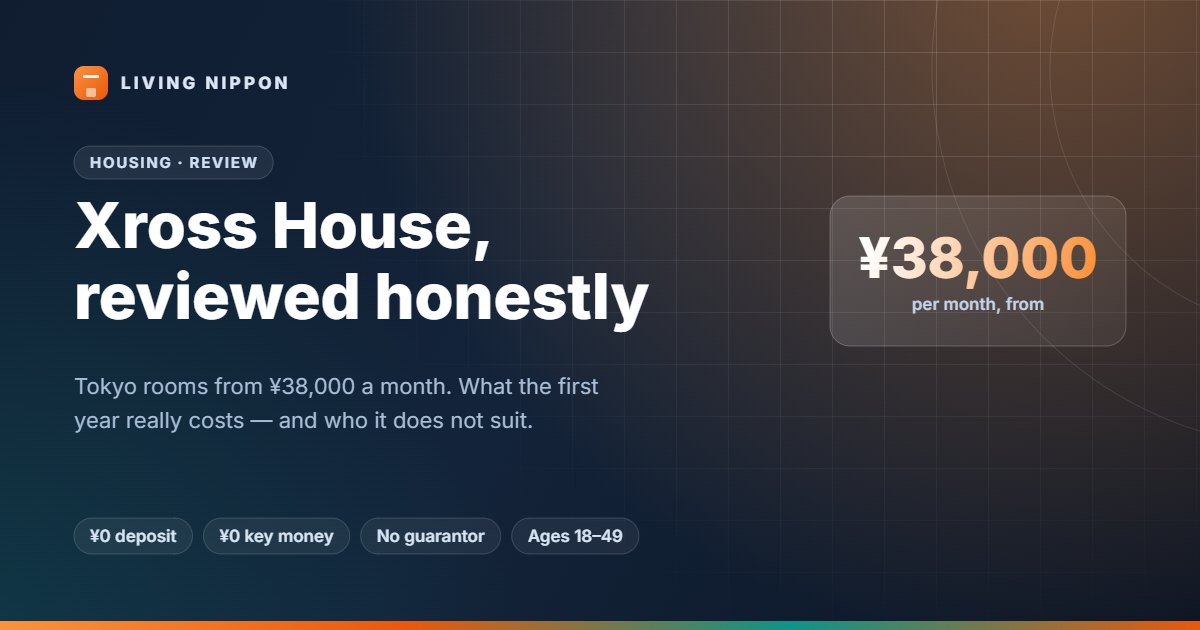
- Rent from ¥38,000/month, deposit, key money and agency fee all ¥0, and a flat initial cost of ¥30,000–¥50,000 by property and plan. No guarantor, but an emergency contact is required.
- Year one at ¥38,000 comes to around ¥506,000, against roughly ¥1,248,000 for a typical ¥78,000 Tokyo apartment — but the room is smaller, and share house facilities are shared.
- Moving between the operator's own properties costs ¥0 in and ¥0 out, even across regions. That is worth roughly ¥390,000 per move on the open market.
- Age 18 to 49 only. Service fees and utilities are not published, so confirm your real monthly total first.
Want to see what ¥38,000 a month actually gets you in Tokyo?
Xross House lists current rooms with photos, rent and nearest station. Browsing commits you to nothing.

If you have been hunting for a room in Tokyo without a guarantor, you have almost certainly run into the name Xross House. The pitch is aggressive: rent from ¥38,000 a month, a flat initial cost in the tens of thousands rather than the hundreds of thousands, no deposit, no key money, no agency fee.
It is real. But those numbers describe the cheapest rooms in the cheapest locations, and most reviews make one basic mistake: treating everything under this brand as a share house. It is not, and that changes who it suits.
What Xross House Actually Is
Xross House (you will also see it written Cross House, XCROSS House or X Cross House) is a Tokyo operator of share houses and furnished apartments, managing more than 6,000 rooms across the city. It is not a listing portal — it runs the buildings itself, which is why it can waive the fees an agent would charge. It also houses staff for 700+ corporate clients, a reasonable signal that the operation is not improvised.
It clearly targets foreign residents: the site runs in 12 languages, from English and Korean through Nepali, Burmese and Sinhala to Vietnamese. If agencies have already turned you down, our guide to renting in Japan as a foreign resident explains why.
Two Products, Not One
The two products cost different amounts and suit different people.
| Share house | Furnished apartment | |
|---|---|---|
| Your space | Private room, or a shared room at the lowest price | Self-contained one-room or 1K unit |
| Kitchen, bath, laundry | Shared with other residents | Your own, inside the unit |
| Cleaning | Common areas cleaned by a service | Your own responsibility |
| Occupancy | Single | Single; some properties permit two |
| Suits | Lowest rent, short stays, meeting people | Privacy, working from home, couples where allowed |
The usual share house complaints — queuing for a shower, negotiating over a shared fridge — apply to the first column only. If privacy matters, the apartment product exists for exactly that: see our guide to furnished apartments in Tokyo. It costs more, but is no compromise.
The Numbers, In One Table
These are the published terms; anything not listed is a question to ask.
| Item | Stated terms |
|---|---|
| Rent | From ¥38,000/month |
| Initial cost package | ¥30,000–¥50,000 by property and plan — confirm the exact figure |
| Deposit, key money, agency fee (shikikin, reikin, chukai-tesuryo — the standard Japanese up-front charges) | ¥0 each |
| Guarantor (hoshonin — someone who covers unpaid rent) | Not required; emergency contact instead |
| Moving to another of its properties | ¥0 in, ¥0 out, including across regions |
| Minimum stay | 1 month |
| Contract | 1 year, cancellable with 1 month's notice |
| Age limit | 18 to 49 only |
| Furniture included | Bed, desk, chair, curtains, air conditioner, refrigerator, microwave, washing machine, TV |
| Futon / mattress | Rental at ¥1,000 + tax per month |
| Service fee and utilities | Not published — confirm before applying |
One honest wrinkle. The advertiser's programme copy quotes a flat ¥30,000 while the landing page shows ¥50,000. We cannot reconcile that from outside, so treat it as a range and confirm the number at the consultation. Every calculation below uses ¥50,000, the conservative end; at ¥30,000, take ¥20,000 off each total.
The one-year contract is what most people misread. You are not locked in: minimum stay is one month and you can leave on one month's notice — see our guide to short-term monthly rentals in Tokyo.
The Honest Cost Comparison
Most reviews compare move-in costs only, which flatters the cheap option enormously. A fair comparison runs a year. Typical rent for a small 23-ward apartment is around ¥78,000/month, and move-in costs there commonly run four to six months' rent once deposit, key money, agency fee, first month, insurance and guarantor fee are counted. We use five.
| First 12 months | Xross House at ¥38,000 | Typical 23-ward rental at ¥78,000 |
|---|---|---|
| Move-in cost | ¥50,000 (conservative) | approx. ¥390,000 (5 × ¥78,000, includes month 1 rent) |
| Rent after move-in | ¥456,000 (12 × ¥38,000) | ¥858,000 (11 × ¥78,000) |
| Year-one total | ¥506,000 | ¥1,248,000 |
The gap is ¥742,000 over twelve months. Even mid-range the maths stays lopsided: a ¥68,000 room costs ¥50,000 + (12 × ¥68,000) = ¥866,000 in year one, still ¥382,000 less, despite rent being only ¥10,000 lower. The saving is front-loaded.
For share houses this is not an apples-to-apples comparison, and we will not pretend it is. A ¥38,000 room is small and the kitchen, bathroom and laundry are shared with strangers: you are trading space and privacy for money. The furnished apartments are self-contained, so that trade does not apply — but they sit higher up the price list.
Two caveats. The ¥506,000 is a floor, not a promise: service fees and utilities are not in the published rent. And five months is typical, not a rule — see our breakdown of initial costs in Japan.
Real Rooms, Real Prices
The advertised ¥38,000 is genuine, but it buys a specific location.
| Property | Rent | Location and line |
|---|---|---|
| Terrace Higashi-Kurume | ¥38,000 | Seibu Ikebukuro Line, roughly 30 minutes to central Tokyo |
| Maison de Madrier | ¥68,000 | Setagaya-Daita, Odakyu Line — inner west Tokyo |
| Luce Nishi-Shinjuku | ¥83,000 | Nishi-Shinjuku-gochome, Toei Oedo Line — central |
| Neo Tokyo Annex | ¥109,000 | Shinagawa area |
Cheap means further out. The spread from ¥38,000 to ¥109,000 is ¥71,000 a month, or ¥852,000 a year, and almost all of it buys back commute time. Note too that the ¥83,000 and ¥109,000 rooms sit at or above the 23-ward average: there you are buying zero initial cost, furniture and no guarantor — not cheap housing.
Check the rent for the station you actually need
Rooms run from ¥38,000 in the outer suburbs to ¥109,000 near Shinagawa. Live listings show rent and nearest station.
Compare rooms and rents by area
Three Things That Genuinely Set It Apart
Moving between its properties is free
The most undersold term here. Switch to another Xross House property and both move-in and move-out cost ¥0, even across regions such as Tokyo to Osaka.
Put a number on it. On the open market every move means paying initial costs again — roughly ¥390,000 at the ¥78,000 rent level, before removal vans and restoration charges. Inside the network you pay nothing. Two moves in three years is on the order of ¥780,000 a normal tenant would have paid and you did not.
The contract is done entirely online
There is no office visit. You can apply and sign from another prefecture, or from outside Japan before you arrive — landing with a room already secured instead of paying for a hotel while you search.
Multilingual support runs on weekends and public holidays
Support in your language runs outside weekday office hours — useful when you are working around a time difference or can only handle admin on a day off.
Who Xross House Does Not Fit
Anyone aged 50 or over
The age limit is 18 to 49. It is a hard eligibility rule, not a preference: at 50 or older there is no point applying.
Anyone needing a city the operator does not cover
This page covers the Tokyo offer. The network reaches other regions, but not everywhere — check your destination at the consultation.
Families with children
Some furnished apartments permit two occupants, so a couple is not automatically ruled out. What is not supported is a family with children: these are one-room and 1K units, and a share house is plainly unsuitable. Couples should ask which properties allow two people, since it varies by building.
People who want to choose their own furniture
The bed, desk, chair, curtains and appliances come with the room — a gift if you land at Narita with two suitcases, a drawback if you own furniture you like. The futon or mattress is a paid rental at ¥1,000 + tax per month, ¥12,000 + tax a year, more than buying one.
Very long-term residents
The zero-initial-cost advantage is a one-time saving of roughly ¥340,000 — about ¥9,400 a month over three years, shrinking the longer you stay. Take a ¥83,000 room when a normal ¥78,000 apartment was open to you, and the normal lease catches up around month 52, a little over four years. The free-transfer term is the counterweight: if you move every couple of years, the calculation swings back the other way.
What the Site Does Not Tell You
First, service fees and utilities. The published rent does not clearly include electricity, gas, water, internet or the common service charge, and those amounts are not on the site. Ask for the total monthly payment in writing, and judge that — not the headline rent — against your budget.
Second, availability. Rooms in popular buildings move fast, and the one you are viewing may already be gone. Treat listings as a guide to each area's price range, not proof a room is free.
Confirm before applying: the exact initial cost, the all-in monthly cost including service fee and utilities, whether the property is a share house or a self-contained apartment, whether two people are permitted, and whether the room is still free.
How the Application Works
The process starts with an online consultation, not a viewing. You submit an enquiry, a staff member goes through your budget, area and move-in date, and only then do you shortlist and sign — all remotely.
No guarantor is required, which is why most foreign residents end up here; that requirement is the wall stopping most applications, as covered in our guide to renting with no guarantor in Japan. You do need an emergency contact the company can reach in a crisis: usually a friend, colleague or relative, in Japan or abroad. Note that the promotional offer is for first-time users of this operator.
The Verdict
For the right reader Xross House is close to the best option going: aged 18 to 49, moving to Tokyo, short on cash, no guarantor, arranging things from abroad, likely to move again within a few years. Take the share house if rent is the binding constraint; take the apartment if shared facilities are not tolerable. For families with children, anyone over 49, or people set on their own furniture, it is the wrong tool. Test it by getting the all-in monthly figure for a real room and comparing it with an apartment you could realistically be approved for.
FAQ
Is Xross House legitimate, or is ¥38,000 a bait price?
The company manages over 6,000 rooms in Tokyo, and ¥38,000 rooms such as Terrace Higashi-Kurume exist. The catch is location and format: the cheapest are small share house rooms about 30 minutes out.
Is the initial cost ¥30,000 or ¥50,000?
Both figures appear in the operator's own material, so treat it as ¥30,000 to ¥50,000 by property and plan, and confirm at the consultation. Deposit (shikikin), key money (reikin) and agency fee (chukai-tesuryo) are ¥0 either way.
Do I have to share a kitchen and bathroom?
Only in the share houses. The furnished apartments are self-contained one-room or 1K units with their own water facilities. Check which type a listing is before you get attached to the rent.
Can my partner live with me?
Some furnished apartments permit two occupants, but it varies by property, so raise it at the consultation. Children are different: these are single-room units, not family housing.
What happens if I have to move for work?
Moving to another of the operator's properties carries no move-in or move-out cost, including across regions such as Tokyo to Osaka. The same move on the open market means paying initial costs again, roughly ¥390,000 at a ¥78,000 rent level.
The only way to know your real monthly cost is to ask
The online consultation is free, runs in your language, and needs no office visit. Get the all-in figure for a real room, then decide.
Start a free online consultation